Short answer: Yes, a mini projector can turn Diwali night into a real movie night — but only if you pick one bright enough for a dim room, sort out the sound separately, and test your wall and throw distance before the guests arrive. Buy the mini projector for the room you actually have, not the picture on the box.
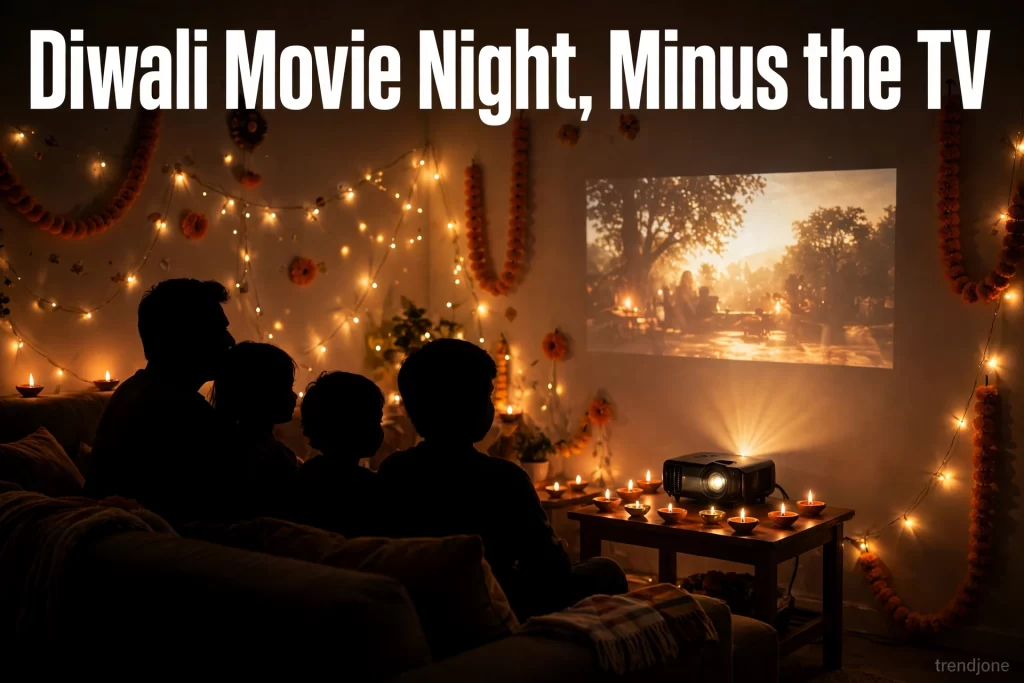
Last Diwali, our plan was simple. Dinner, diyas, a few sparklers outside, and then everyone would drift to their own phones. Instead, my cousin pulled a shoebox-sized projector out of his bag, pointed it at the living-room wall, and within ten minutes twenty of us — grandparents included — were watching an old family favourite on a screen bigger than any TV we own. Nobody checked their phone for two hours. That is a rare sentence in my house, and it is why I bought my own mini projector this year.
But here is the part the unboxing videos skip: my first night with my own projector was a mess. The picture looked washed out, the sound was thin enough to disappear under the kitchen noise, and I spent half an hour moving a side table back and forth trying to get the image to fit the wall. The second night, with a few fixes, it was wonderful. The difference was not a better projector. It was knowing what actually matters.
What a mini projector really is — and what it is not
A mini projector is a small, portable projector, usually the size of a thick paperback, that throws a 40- to 100-inch image onto a wall or screen. Most budget models cost a fraction of a TV, run on a built-in battery or a power adapter, and connect over Wi-Fi, Bluetooth, or HDMI. That portability is the whole point. You can carry it to a relative’s house, set it on a stool, and have a cinema in a room that has never had one.
What it is not is a replacement for a good TV in a bright room. Projectors do not fight sunlight or tube lights well. If your Diwali evening happens in a room with the main lights blazing, even a decent mini projector will look pale. The trick is timing: projectors shine after dark, in a dimmed room, with curtains drawn. Diwali night, conveniently, is exactly that setting.
The three mini projector specs that actually matter
Ignore most of the numbers on the box. Three things decide whether your movie night works or flops.
1. Brightness, in ANSI lumens, not “LED lumens.” Sellers love to print huge numbers like 12,000 lumens. That is usually LED lumens, a marketing figure. Look for ANSI lumens instead. For a dim room, 200–300 ANSI lumens is workable; below 150, you will be squinting. If you can only find LED lumens, treat anything under 8,000 with suspicion for anything but a very dark room.
2. Native resolution. Many cheap projectors advertise “1080p supported” while their actual panel is 480p. “Supported” means it can accept the signal, not display it sharply. Check for “native 720p” as a minimum. Native 1080p is better if your budget allows, but native 720p on a 60-inch image in a dark room still looks perfectly enjoyable for a family film.
3. Sound. This is the one I underestimated. Most mini projectors have a tiny speaker that sounds like a phone in a mug. It is fine for one person in a quiet bedroom. It is not fine for fifteen people, a fan running, and someone frying pakoras in the next room. Budget for sound separately: a basic Bluetooth speaker, or even a wired speaker you already own, transforms the experience more than any picture upgrade.
Setting it up: the 20-minute rehearsal that saves the evening
Do not unbox the projector for the first time when guests are already seated. Do a rehearsal the night before. Pick your wall — plain, light-coloured, and as flat as possible. A light cream wall works; a textured or dark wall dulls the picture badly. If your wall is busy, a plain white bedsheet pulled tight works surprisingly well as a screen, though a cheap foldable screen is better if you plan to repeat this.
Next, measure the throw distance. Every projector needs a certain distance from the wall to make a certain image size, and small rooms punish you here. A “short throw” model helps in a small flat, but most budget models need 1.5 to 2.5 metres for a 60- to 80-inch picture. Put the projector on a stable stool or tripod — a stack of books wobbles every time someone walks past, and a wobbling picture ruins a film faster than a dim one.
Finally, test your content source before the night. Streaming apps on some budget projectors are limited, and screen mirroring from a phone can stutter on weak Wi-Fi. The most reliable setup I have found is boring: a laptop or phone connected by HDMI cable, or a downloaded film on a USB stick plugged straight into the projector. Download the film in advance. Festival-week Wi-Fi, with everyone home and streaming, is not the moment to discover your connection cannot hold a stream.
What I would buy, and what I would skip
If I were buying again today, I would pick a native 720p model with at least 250 ANSI lumens, auto-keystone correction (it squares up the picture when the projector sits at an angle, which it always does in a real living room), and a headphone or audio-out jack so I can plug in a proper speaker. Battery power is nice for a terrace screening, but for an indoor Diwali night, mains power is fine and cheaper models without a big battery are often brighter for the price.
I would skip the ultra-cheap models under a certain price that promise everything — 4K, huge brightness, giant screen — for the cost of a dinner out. In projectors, that price usually buys a dim 480p image and a fan louder than the dialogue. I would also skip buying an expensive branded screen on day one. Try the wall first. If movie nights become a habit, then spend on the screen.
The part nobody talks about: it is about the gathering, not the gadget
Here is my honest opinion after two Diwali seasons with a projector: the gadget is the excuse, not the event. What made that first night special was not the resolution. It was my grandfather, who never watches films on a phone, sitting in the front row asking someone to turn it up. It was cousins who had not sat together in a year sharing a blanket and arguing about which film to play. A TV could have done the same job technically. But a TV cannot move to the terrace, or to a cousin’s house, or onto a sheet hung between two chairs in a courtyard.
That portability is what you are really buying. If your family already gathers around a big TV happily, you do not need this. If your gatherings scatter across rooms and phones, a mini projector gives everyone one shared screen again — and on Diwali night, that is worth more than any spec sheet.
Quick checklist before you buy
- Native resolution 720p or higher — ignore “supported” claims.
- Brightness in ANSI lumens, 200+ for a dim room.
- A plan for sound: Bluetooth speaker or audio-out, not the built-in speaker alone.
- Throw distance that fits your room — measure before ordering.
- Auto-keystone if the projector will sit off-centre, which it will.
- A downloaded film or HDMI source ready — do not rely on festival-night Wi-Fi.
Frequently asked questions
Can a mini projector work in a room with lights on? Poorly. Dim the room and draw the curtains. Projectors are evening devices, and Diwali night is their best use case.
Do I need a special screen? No, to start. A plain light wall works. A white bedsheet pulled tight is a decent stand-in. Buy a screen only if movie nights become regular.
Is the built-in speaker enough? For one or two people in a quiet room, yes. For a family gathering, no — pair it with any Bluetooth or wired speaker you already own.
Can I use it outdoors on the terrace? Yes, after dark, with a power source and a plain surface. Wind moving a bedsheet screen is the main enemy, so fix the sheet properly.
Is a mini projector good for daily TV watching? Honestly, no. For daily use a TV is sharper, brighter, and simpler. A mini projector is best as an occasional, portable big-screen experience.
So: buy for your real room, fix the sound, rehearse once, and download the film early. Do that, and your Diwali movie night will look a lot more like the videos — minus the part where everything works perfectly on the first try, because in real houses, it never does. And that is fine. The second try is usually the one everyone remembers.