Short answer: For most people in 2026, the right wireless charger is a 15W Qi-certified pad or stand from a known brand, costing ₹1,000–₹2,000, with a proper adapter included or a clear adapter requirement in the box. iPhone users should look for MagSafe-compatible chargers (magnetic alignment, 15W on newer models); Android users should check whether their phone supports 15W Qi or a faster proprietary standard. Skip no-name 10W pads under ₹500 — they charge slowly, heat up, and often stop working when your phone has a case on. A stand beats a flat pad for a desk, because you can see notifications and take calls while charging.
I bought my first wireless charger the way most people do — because it looked good on a desk. A slim round pad, ₹699, “fast charging” on the box. It charged my phone, technically. It also took three hours to go from 20% to 80%, got warm enough that I worried about the battery, and stopped charging entirely whenever my phone shifted a few millimetres off-centre during the night. I woke up twice to a phone at 34%. The charger I use now cost twice as much and does half the showing off — but it charges at full speed, holds the phone in place with a magnet, and has never once left me with a dead battery in the morning. The difference was not the brand name. It was knowing what actually matters before buying.
1. Watts are not what they seem: the real speed limits
Wireless charger boxes love big watt numbers — 15W, 20W, even 50W. What they do not say clearly is that your phone decides the actual speed, not the charger. An iPhone caps standard Qi charging at 7.5W and MagSafe at 15W (25W on the newest models with the right adapter). Most Android phones cap Qi at 15W, unless they support a brand-specific fast wireless standard — Samsung’s Fast Wireless Charging 2.0 goes to 15W, some Xiaomi and OnePlus phones go faster but only with their own brand’s charger. A 50W charger will not make a 15W phone charge at 50W. What actually matters: buy a charger that matches your phone’s ceiling, and make sure it comes with — or clearly specifies — a power adapter strong enough to feed it. A 15W charger plugged into a weak 5W adapter will charge at 5W, and the box will not warn you about that. If the charger has no adapter in the box, budget ₹500–₹800 for a good 20W USB-C PD adapter.
2. Pad vs stand vs MagSafe: pick the shape for the place
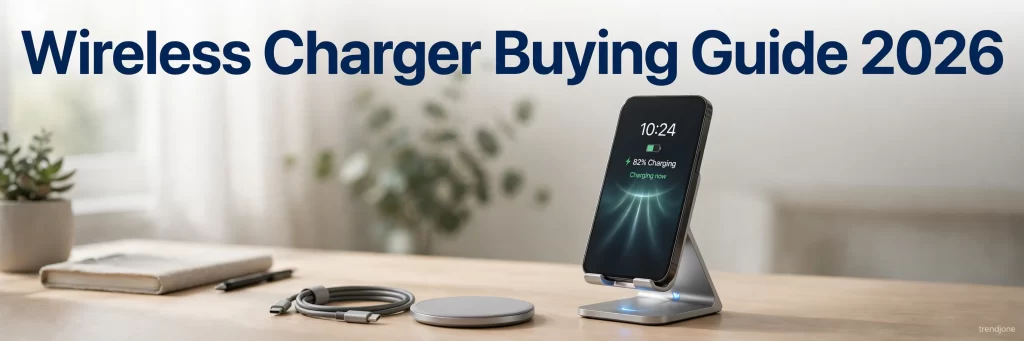
The shape matters more than people think, because it decides where the charger lives. A flat pad is best for a bedside table — you drop the phone on it half-asleep and it works. A stand is best for a desk — the phone sits upright, so you can see the time, read notifications and take a video call while it charges. A magnetic charger (MagSafe for iPhone, or magnetic rings for Android) is best if you move around, because the magnet snaps the phone into exactly the right spot every time — no more waking up to a phone that slid off-centre and stopped charging at 2 AM. My own setup is a stand on the desk and a magnetic pad by the bed, and I would not swap them. One warning: if your phone has a thick case, a metal ring, or a pop socket, test it — some cases block wireless charging or weaken the magnetic hold, and the fix is either a thinner case or a MagSafe-compatible case.
3. Heat is the hidden cost of wireless charging
Here is my honest opinion: heat is the one thing wireless charger reviews do not talk about enough. Wireless charging is less efficient than a cable — some energy always becomes heat — and heat is the enemy of battery health over time. A cheap charger with no temperature control will keep pumping power into a warm phone all night. A good charger slows down or pauses when the phone gets hot, and some even have a small fan. You will not notice the difference in a week. You will notice it in a year, when your battery health is 88% instead of 94%. Practical rules: do not charge on a wireless pad under a pillow or inside a closed drawer, do not use a wireless charger in a hot car in summer, and if your phone feels noticeably hot on the pad, that charger is not doing its job. Overnight charging is fine with a good charger — it trickle-charges once full — but with a cheap one, a cable is kinder to the battery.
4. One charger for everything, or one per device?
If you own a phone, earbuds and a smartwatch, a 3-in-1 charging station looks like the obvious answer — one cable, one spot, everything charged. It is a good idea, but only if you buy the right one. Cheap 3-in-1 stations often charge the phone slowly because they split a weak power supply three ways, and the watch charger may not fit your watch model at all (Apple Watch needs its own puck, Galaxy Watch needs its own too). Before buying, check three things: the total wattage of the included adapter (a real 3-in-1 needs at least 30W), whether the watch spot matches your watch, and whether the earbuds spot works with your case. If any answer is no, buy a good single-phone charger now and add the rest later. A single excellent charger beats a mediocre three-in-one every time.
5. What to pay — and the traps to avoid
Fair prices in 2026: a good 15W Qi pad or stand from a known brand costs ₹1,000–₹2,000; a MagSafe-compatible magnetic charger costs ₹1,500–₹3,000 (Apple’s own is more, and third-party MagSafe-certified ones are the smart buy); a good 3-in-1 station costs ₹2,500–₹4,500. What is not worth paying for: chargers advertising wattage your phone cannot use, “gaming” chargers with RGB lights (the lights do nothing for charging), and any charger under ₹500 with no Qi certification — uncertified chargers are the ones that overheat, charge slowly, and sometimes damage the phone’s battery. Also skip chargers that force you to remove your case every time; a charger that only works case-free is a charger you will stop using in a week. My rule now: Qi-certified, right wattage for my phone, adapter included or budgeted, and a shape that fits the spot it will live in.
My honest recommendation
If you want one answer: buy a 15W Qi-certified stand from a brand you recognise, for the desk where you spend your day, with a 20W USB-C adapter. If you have an iPhone, make it magnetic — the snap alignment alone is worth the extra ₹500, because it ends the “phone slid off the pad” problem forever. Live with it for a month. If you love it, add a magnetic pad by the bed. And keep one cable charger around for the days you need speed — wireless is for convenience, not for emergencies. A wireless charger earns its place when you stop thinking about charging at all, and the right one does exactly that.
FAQ
Is wireless charging bad for my phone battery?
Not with a good charger. Heat is the real risk — cheap chargers without temperature control keep a warm phone charging all night, which wears the battery faster. A Qi-certified charger from a known brand manages heat and slows down when needed. Avoid charging on a pad under a pillow or in a hot car.
Why is my wireless charger so slow?
Usually one of three reasons: the adapter is too weak (a 15W charger on a 5W adapter charges at 5W), the phone is not aligned on the coil, or the phone’s own cap is lower than the charger’s rating — iPhones cap standard Qi at 7.5W. Use the recommended adapter, centre the phone, and check your phone’s real wireless charging limit.
Do wireless chargers work with a phone case?
Most thin cases (under 3mm, plastic or silicone) work fine. Thick cases, metal cases, wallet cases with cards, and pop sockets can block charging or weaken the magnetic hold. If charging keeps failing, try without the case — if it works, the case is the problem, and a MagSafe-compatible case is the fix.
Is MagSafe worth it for iPhone users?
Yes, for most iPhone users. The magnet snaps the phone into perfect alignment every time, which ends missed charges, and it charges at 15W instead of the 7.5W standard Qi cap. Third-party MagSafe-certified chargers offer the same benefits for less than Apple’s own.
Can I leave my phone on a wireless charger overnight?
Yes, with a good charger — modern phones and certified chargers stop at 100% and trickle-charge. With a cheap uncertified charger, overnight charging means hours of unnecessary heat. If your phone feels hot on the pad in the morning, switch to a better charger or use a cable at night.