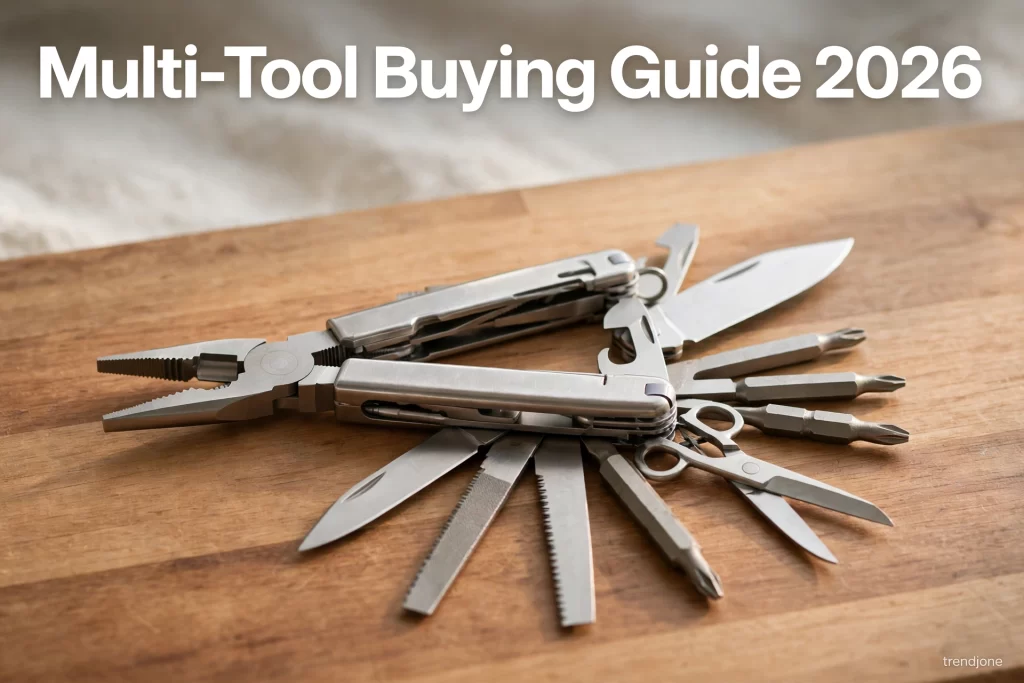
Short answer: For home and everyday use, buy a pliers-based multi-tool with a locking knife blade, needle-nose pliers, a Phillips and a flat screwdriver, scissors, and a saw — in stainless steel, weighing 200–280 grams, with tools that lock open. That combination covers 90% of small jobs: cutting boxes, tightening screws, fixing a loose wire, opening a package, trimming a thread. Expect to pay ₹1,500–₹4,000 for a good one in 2026; below ₹800 you usually get soft steel that won’t hold an edge and pliers that bend. A multi-tool does not replace a toolbox — it replaces the trip to the toolbox for the small jobs, which is most of them.
I bought my first multi-tool at a railway station stall for ₹350, and I learned exactly what ₹350 buys. The knife went blunt opening two cardboard boxes. The pliers bent the first time I gripped a stiff nut. The screwdriver tip chipped on the second screw. Within a month it was rattling in a drawer, and I was back to walking to the toolbox for every small job. My second multi-tool cost ₹2,800, and it has lived in my pocket or my bag for four years now. It has opened a hundred boxes, tightened every loose screw in my house, cut wire, stripped a cable, fixed a wobbly chair, and once — during a power cut — helped me change a fuse in the dark. The difference between the two was not the number of tools. Both claimed twelve functions. The difference was the steel, the locks, and the pliers. This guide is about those three things, because they are what separate a tool from a toy.
1. Pliers-based or knife-based: pick the right shape
Multi-tools come in two shapes, and the shape decides what the tool is good at. A pliers-based multi-tool folds out from a pair of pliers — the pliers are the main tool, and everything else (knife, screwdrivers, scissors) folds out of the handles. This is the classic design and the right choice for home use, because pliers are the tool you reach for most: gripping, bending wire, pulling a nail, holding something small while you work on it. A knife-based multi-tool is built around a folding knife, with a few extra tools tucked in — lighter and slimmer, but the pliers, if it has them at all, are small and weak. There are also keychain multi-tools, tiny ones with four or five functions that fit on a keyring. They are fun and genuinely useful for opening a bottle or tightening a glasses screw, but they are not a home tool. My honest take: for a first multi-tool, buy pliers-based, full-size. It is heavier in the pocket, but it is the only shape that actually does the jobs you buy it for.
2. The tools that matter — and the ones that don’t
Every multi-tool claims twelve or fifteen or twenty-one functions, and half of them are padding. The tools that actually matter: needle-nose pliers (with a wire cutter built into the base — check that the cutter is a separate hardened edge, not just a notch in the pliers), a plain-edge knife blade that locks open, a Phillips screwdriver, a flat screwdriver, scissors, and a small saw. Those six cover almost everything. Useful extras: a bottle opener, a can opener, an awl for punching holes in leather or plastic, and a file. What you can ignore: a corkscrew on a tool you carry in India, a “fish scaler”, a ruler printed on the handle that you will never read, and any tool that is too small to grip properly. The test in a shop is simple: open each tool, close it, and ask whether you could actually use it with one hand while holding something with the other. If a tool is awkward to open or too small to hold, it does not count, however many functions the box claims.
3. Size and weight: the tool you carry beats the tool in the drawer
A multi-tool only helps if it is with you when the job appears. A full-size multi-tool weighs 200–280 grams and is about 10 cm long when closed — it fits in a pocket, but you will feel it, and it needs a belt sheath or a bag pocket to be comfortable all day. A mid-size tool at 150–200 grams is the sweet spot for most people: light enough to carry, heavy enough to grip properly. Below 120 grams, the pliers get too small for real work and the knife blade gets too short to be useful. Length matters too: a closed length of 9–11 cm fits an average hand; shorter than that and the handles dig into your palm when you squeeze the pliers hard. Try before you buy if you can: hold the pliers closed in your fist and squeeze. If the handles pinch or the tool feels like it will slip, it is the wrong size for your hand. A multi-tool is a personal thing — the same tool fits one person’s hand and not another’s, and no review can tell you which one yours is.
4. Build quality: steel, locks and one-hand opening
Three things decide whether a multi-tool lasts four years or four weeks. First, the steel. Look for stainless steel with a named grade — 420HC, 440C or similar — or a known brand’s own steel. Unnamed “stainless steel” on a ₹500 tool is usually soft steel that goes blunt fast and rusts at the joints. Second, the locks. Every blade and saw should lock open while you use it — a folding knife that can close on your fingers is dangerous, not just annoying. Open the blade, push it gently from the side, and check that it does not move. Cheap tools skip locks on some tools; do not accept that. Third, one-hand opening: on a good tool you can open the knife with one hand (a thumb stud or a nail nick that actually works), because your other hand is usually holding the thing you are cutting. Also check the pliers action — they should open and close smoothly without grinding, and the jaws should meet evenly when closed. If the jaws do not meet, the pliers will never grip a small nut properly. These checks take thirty seconds in a shop and they tell you more than any review.
5. What to pay — and which brands are worth it in India
Fair prices in 2026: a decent mid-size multi-tool from a known brand costs ₹1,500–₹4,000. Leatherman is the benchmark — excellent, but ₹6,000–₹12,000 in India and often overkill for home use. Victorinox (the Swiss Army people) makes superb knife-based tools at ₹2,500–₹5,000. Gerber and SOG sit in the middle. For a budget buy, look at Indian-market brands like Stanley or Taparia’s multi-tools (₹1,200–₹2,500), which are honestly built and easy to service. Below ₹800, you are buying soft steel and no locks — my railway-station lesson. What is not worth paying for: a “tactical” black coating (it scratches off and hides rust), a 21-function claim when you only need six tools, and a fancy sheath that costs as much as the tool. What is worth paying for: a brand with a warranty you can actually claim in India, and a tool you have held in your hand before buying. The best time to buy is during online sales, when good multi-tools often drop 20–30%. And keep it oiled — one drop of machine oil on each joint every few months keeps a good tool smooth for years.
My honest recommendation
If you want one answer: buy a pliers-based, mid-size multi-tool in stainless steel, 150–250 grams, with a locking knife, needle-nose pliers with a wire cutter, Phillips and flat screwdrivers, scissors and a saw. Spend ₹1,500–₹3,000, and buy it from a brand you can get serviced or replaced in India. Carry it in your bag or on your belt for a month and notice how many small jobs it does — the box you open, the screw you tighten, the wire you cut — without a trip to the toolbox. A multi-tool will never replace a real drill or a real saw. But for the hundred small jobs that make up most of home life, the tool in your pocket beats the toolbox in the cupboard every single time.
FAQ
What is the best multi-tool for home use?
A pliers-based, mid-size multi-tool in stainless steel with a locking knife, needle-nose pliers, Phillips and flat screwdrivers, scissors and a saw. It covers 90% of small home jobs. Avoid knife-based tools as your only multi-tool — their pliers are too small for real work.
How much should a good multi-tool cost in India?
₹1,500–₹4,000 for a good one from a known brand. Below ₹800 you usually get soft steel, no blade locks and pliers that bend. Premium brands like Leatherman cost ₹6,000–₹12,000, which is more than most homes need.
Are cheap multi-tools worth buying?
Usually not. Cheap multi-tools use soft steel that goes blunt quickly, skip locks on the blades, and have pliers that bend under load. A ₹2,000 multi-tool that lasts four years is cheaper than four ₹500 tools that each last a month.
Can I carry a multi-tool every day in India?
Yes, for practical use — but be sensible. A multi-tool is a tool, not a weapon, and carrying one in a bag or on a belt for work is normal. Avoid carrying a large locking blade into high-security areas like airports, metro stations or courts, where it will be confiscated.
How do I maintain a multi-tool?
Wash it with warm water and soap after dirty jobs, dry it fully, and put one drop of machine oil on each pivot every few months. Sharpen the knife blade with a basic whetstone or a pull-through sharpener when it stops cutting paper cleanly. Store it dry — moisture in the joints is what causes rust.