
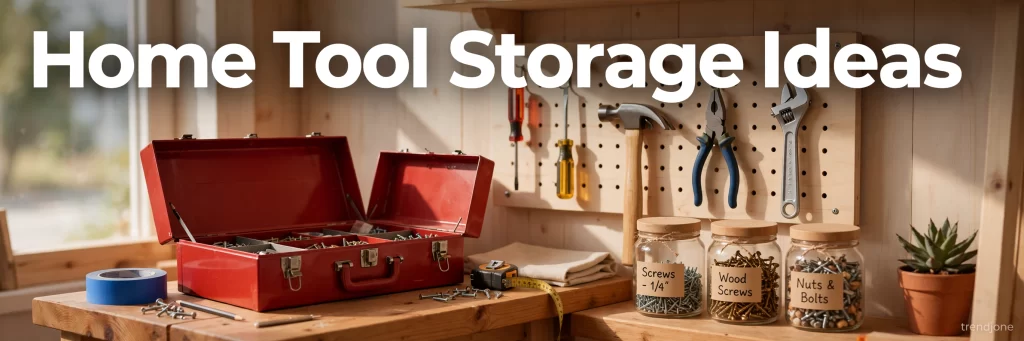
Short answer: For most homes, one medium toolbox (16–19 inch) with a lift-out tray, plus a small wall hook strip or a pegboard, solves tool storage completely. Keep daily tools (screwdrivers, pliers, hammer, tape, torch) in the tray, heavier tools below, and hang the five tools you reach for most on the wall where you can see them. The system that works is the one you can maintain in thirty seconds after a job — if putting a tool away takes longer than using it, you will not do it, and the drawer chaos returns within a month.
Last month my bathroom tap started leaking at 9 PM. I knew I owned a wrench — I had bought one two years ago. I spent twenty minutes searching: the kitchen drawer, the balcony shelf, a plastic bag in the storeroom, and finally under a pile of old newspapers, where it was rusting gently. The leak took five minutes to fix. The search took four times longer. That night I did what I should have done years ago: I gathered every tool in the house into one pile, threw away the duplicates and the broken ones, and gave the rest a proper home. It took one evening. It has saved me time every week since.
1. Start by gathering everything — the pile never lies
Before buying any storage, do the pile test: collect every tool from every drawer, bag, shelf and box in the house and put them all on one table. Most people are shocked twice — first by how many tools they own, and second by how many are duplicates. I found three screwdrivers I had forgotten, two hammers, and a set of Allen keys from furniture I no longer own. Sort the pile into three groups: tools you use at least once a month, tools you use rarely but need (the pipe wrench, the stud finder), and tools that are broken, rusted beyond use, or duplicates you will never reach for. Throw away or give away the third group. Storage bought for tools you do not need is just a more expensive mess. My own pile shrank from 40-odd items to 23, and suddenly a normal toolbox was big enough.
2. The toolbox: medium beats big, every time
The most common tool-storage mistake is buying the biggest toolbox in the shop. A huge box gets heavy, lives on the floor of the storeroom, and you stop carrying it to the job — which defeats its purpose. A 16–19 inch toolbox with a lift-out tray is the right size for a home: the tray holds the daily tools (two screwdrivers, pliers, a cutter, a torch, insulation tape), the deep bottom holds the hammer, the adjustable wrench, and the measuring tape. Look for a box with a proper latch that stays shut when you carry it, a handle that does not dig into your hand, and — this matters more than it sounds — a flat lid you can set screws and small parts on while you work. Plastic boxes (₹500–₹1,200) are fine for most homes; metal boxes last longer but cost more and rust if kept in a damp balcony. One box, not three. If your tools do not fit in one medium box, you own too many tools, not too little storage.
3. Hang the five you use most — visibility beats tidiness
Here is the principle that changed my setup: the tools you use most should be visible, not hidden. A small pegboard (₹300–₹600 for a basic one) or even a strip of hooks on the inside of a cupboard door does the job. Hang your five most-used tools — in my case the hammer, the adjustable wrench, the big screwdriver, the pliers, and the torch — at eye level. When a tool has a visible, empty hook, two things happen: you can see at a glance what is missing, and putting it back takes two seconds instead of opening a box, finding the right slot, and closing it again. The toolbox holds everything else; the wall holds the daily five. The one rule: never hang a tool you use once a year — the wall is prime real estate, and the pipe wrench does not live there.
4. Small parts need small boxes — the screw-and-nail problem
Tools are the easy half of storage. The hard half is the small stuff: screws, nails, wall plugs, batteries, cable ties, and the little Allen keys that come with every piece of flat-pack furniture. Left loose, they migrate to the bottom of every drawer in the house. The fix is cheap: a small parts organiser with adjustable dividers (₹200–₹400) or even a few labelled jam jars. I use one organiser with six compartments — screws, wall plugs, nails, batteries, cable ties, and “mystery fasteners from furniture” — and a label on each compartment, because a box you cannot read is a box you will not open. Keep the organiser inside the toolbox or on the same shelf, never in a different room. And the golden rule: when you finish a job, the leftover screws go back in the organiser before you wash your hands. Five seconds now saves a twenty-minute search later.
5. Where the toolbox lives matters as much as the box
A perfectly organised toolbox in the wrong place is useless. The right place has three qualities: it is dry (a damp balcony rusts tools in one monsoon), it is reachable without moving three other things, and everyone in the house knows where it is. In most Indian flats, that means a shelf in the utility area, the top of a wardrobe in the passage, or a corner of the storeroom you can actually walk to. Not the loft — nobody climbs into a loft to fix a leaking tap. Not the kitchen — cooking steam and oil mist are terrible for tools. Put the toolbox where the jobs happen: near the main rooms, not at the far end of the house. And tell the family where it is. A toolbox only you can find is a toolbox nobody uses, and you become the permanent on-call repair person for every loose screw in the house.
6. The thirty-second rule — the system that survives real life
Every storage system works on the day you set it up. The question is whether it still works a month later. Mine works because of one rule: after any job, every tool goes back before I sit down — and it takes less than thirty seconds, because every tool has one obvious home. If putting a tool away takes longer than that, the storage is wrong, not you. Two habits keep it alive: a five-minute tidy on the first Sunday of every month (wrench back on its hook, screws back in the organiser, one quick wipe of the box), and a strict one-in-one-out rule — a new tool only enters the box when an old, broken, or duplicate one leaves it. That is how a toolbox stays at 23 tools instead of creeping back to 40. Storage is not a purchase. It is a habit with a box attached to it.
My honest recommendation
If you want one answer: do the pile test this weekend, keep the 20-odd tools you actually use, and buy one medium toolbox with a lift-out tray (₹700–₹1,000) plus a small hook strip for your five most-used tools. Put the box somewhere dry and reachable, label one small organiser for screws and plugs, and follow the thirty-second rule. Total cost: under ₹1,500, one evening of work. You will never again spend twenty minutes looking for a wrench while a tap leaks — and that, more than any shiny new tool, is what a well-stored toolbox actually buys you.
FAQ
What is the best toolbox for home use in India?
A 16–19 inch plastic toolbox with a lift-out tray, a proper latch, and a comfortable handle — about ₹500–₹1,200. Medium beats big: a huge box gets heavy, lives in the storeroom, and never reaches the job. One medium box fits the 20-odd tools a home actually uses.
How do I organise tools in a small flat?
One medium toolbox for everything, plus a small pegboard or hook strip inside a cupboard door for the five tools you use most. Keep a small labelled organiser for screws, nails and wall plugs. Store the box somewhere dry and reachable — a utility shelf, not the loft or a damp balcony.
Should I use a pegboard or a toolbox?
Both, for different jobs. The toolbox holds everything and travels to the job; the pegboard or hook strip holds your five most-used tools where you can see and grab them in two seconds. Hanging everything looks good in photos but wastes wall space on tools you use once a year.
How do I stop my tools from rusting?
Keep them dry — never store tools on a damp balcony or near the bathroom. Wipe tools dry after use, keep a small silica gel packet in the toolbox, and put a light wipe of oil on rarely-used metal tools before the monsoon. Rust starts with moisture, not with age.
What tools should every home toolbox have?
A claw hammer, two screwdrivers (flat and Phillips), combination pliers, an adjustable wrench, a measuring tape, a cutter, insulation tape, a torch, and a small parts organiser for screws and wall plugs. That set handles about 90% of home repairs; add specialist tools only when a real job needs them.