
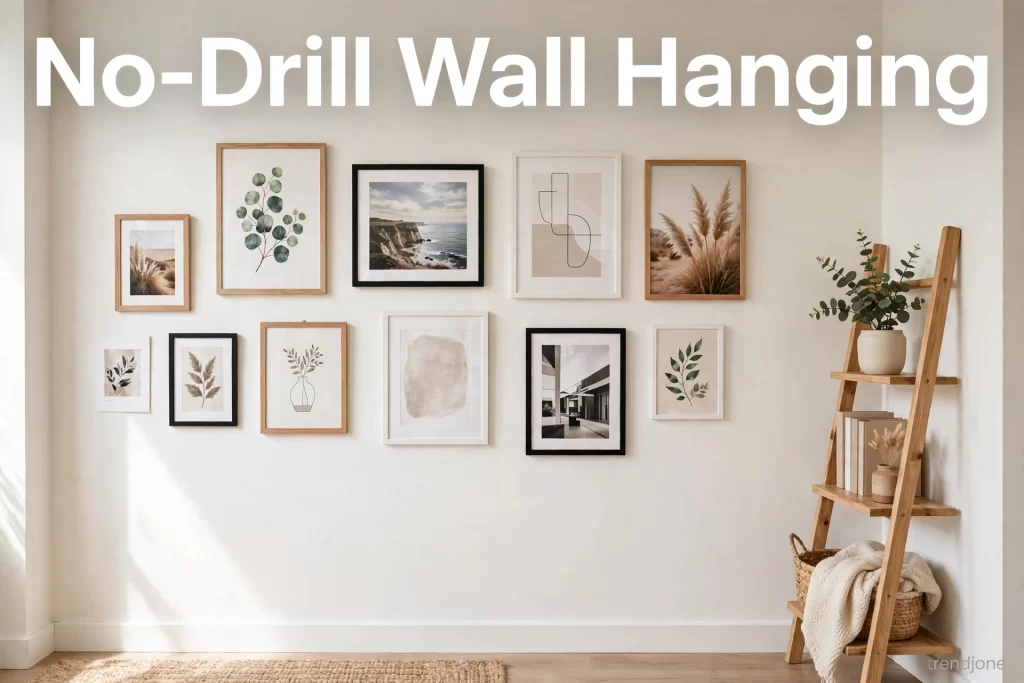
Short answer: For rented walls, the right no drill wall hanging tool depends on the weight: adhesive strips and hooks hold up to 2–3 kg (frames, small shelves, fairy lights), picture-hanging strips hold frames flat without tilting, and tension rods plus leaning shelves handle everything heavier without a single hole. The trick is matching the tool to the weight and the wall surface — smooth paint, tile and glass love adhesives; textured or damp walls don’t — and removing them slowly with heat, never by yanking.
The first flat I rented, I hung nothing. Not one frame, not one shelf, not even a clock — because the landlord’s rule was clear (no holes in the walls) and my fear was clearer (losing the deposit). The flat looked like a waiting room for a year. Then a friend showed me her rented flat, which had frames, a spice shelf, fairy lights, a full-length mirror — all hanging, all without a single hole — and I realised the problem was never the rule. It was that I didn’t know the tools. Three years and several flats later, these are the no-drill hanging tools I actually trust: the ones that held through a whole tenancy, came off cleanly at the end, and never once cost me a rupee of deposit.
1. Adhesive strips: the no drill wall hanging workhorse (use them right)
Adhesive hanging strips are the single most useful no-drill tool, and also the most misused. The rules that make them work: clean the wall first with a dry cloth (dust is the enemy — a strip stuck to dust is a strip stuck to nothing), press firmly for a full 30 seconds, and then wait an hour before hanging anything. That last rule is the one everyone breaks, and it’s the reason frames fall at 2 am. Match the strip to the weight — use the size rated for your frame, and for anything over 1.5 kg, use two pairs instead of one. And buy the removable kind: the good ones stretch off cleanly when you pull the tab slowly, while the cheap ones tear the paint with them. I’ve had the same set of strips hold a framed photo through two summers and a monsoon; the one time a frame fell, I’d hung it five minutes after sticking the strip. The no drill wall hanging tool wasn’t the problem — my patience was.
2. Picture-hanging strips for frames that sit flat
Regular hooks leave frames tilting forward and swinging whenever someone walks past. Picture-hanging strips — the interlocking kind, one half on the wall and one on the frame — hold the frame flat against the wall, exactly like a nail would. They also let you reposition the frame without re-sticking anything: lift it off, adjust, press it back. For gallery walls (three or four frames in a row), they’re the difference between a wall that looks hung and a wall that looks arranged. The limit is weight — most top out around 2–3 kg per pair — so a big, glass-fronted frame needs two pairs, and a heavy wooden frame needs a different solution entirely. But for the standard photo frames, certificates and small art prints that make a rented flat feel like yours, they’re the tool I reach for first.
3. Adhesive hooks for no drill wall hanging: small, strong, everywhere
Hooks are the quiet heroes of a rented home. A row of small adhesive hooks inside a cupboard door holds measuring cups; two by the entrance hold keys and a mask; a couple in the bathroom hold a towel and a loofah; one behind the bedroom door holds tomorrow’s clothes. The trick is buying hooks rated for the actual weight — a hook rated for 1 kg will hold a 1 kg towel happily for a year and will drop a 2 kg bag in a week — and sticking them to the right surface. Smooth painted walls, tiles, glass and metal are ideal. Rough, textured plaster and damp bathroom walls are not; on those, the adhesive never gets a full grip. Test one hook for a day before you commit to a whole row, and put the row where you’ll actually use it: hooks in the wrong place are just decoration, and decoration that holds nothing is clutter.
4. Tension rods: shelves and curtains with zero damage
A tension rod is a spring-loaded bar that wedges between two walls, and it’s the most underrated tool in a rented home. Inside a kitchen cabinet it creates an instant extra shelf for cutting boards; under a sink it holds spray bottles by their triggers; in a window frame it hangs a curtain with no rod brackets at all. The rule is to measure the gap properly — a rod that’s barely stretched holds nothing, and a rod stretched to its limit will slip at the worst moment — and to keep the load light and centred. I use one in the wardrobe for scarves and one in the bathroom for a small hanging basket. Nothing is screwed, nothing is stuck, and at moving-out time the whole thing comes down in ten seconds. If your flat has one awkward gap — between two walls, inside a cupboard, across a window — a tension rod probably solves it.
5. Leaning shelves and furniture for no drill wall hanging
Some things are simply too heavy to stick to a wall, and that’s where leaning furniture earns its place. A leaning ladder shelf stands against the wall on its own feet — books, plants and a lamp on the lower rungs, nothing attached to the wall at all. The same goes for a leaning full-length mirror and a leaning desk shelf. The key is weight low and centre of gravity down: heavy things on the bottom rungs, light things on top, and nothing that a child or a pet could pull over. If the shelf feels wobbly, it needs a wider base, not a screw — and in a home with small children, a leaning shelf still deserves a discreet anti-tip strap at the back. But for most adult flats, leaning furniture is how you get a shelf wall without ever touching the plaster.
6. Removing your no drill wall hanging cleanly (the deposit-saving step)
Hanging things is only half the job in a rented flat — the other half is taking them down at the end without leaving a mark. The method that has never failed me: warm the adhesive gently with a hair dryer for 20–30 seconds, then pull the tab slowly, straight down along the wall, keeping the stretch slow and steady. Never yank a strip sideways or pull it away from the wall — that’s what takes paint off. For hooks, twist slightly while pulling down. Then wipe the spot with a damp cloth and check it in daylight; if there’s a faint mark, a magic-eraser sponge usually takes it off. Do this the day before the final inspection, not in a rush on moving day, and take a photo of each clean wall. In three flats, this routine has returned my full deposit every time — and the landlords, honestly, couldn’t tell anything had ever been hung.
With the frames up, the no drill wall hanging is done. The last thing to sort is the air itself. Closed windows trap dust and Diwali smoke, so my air purifier buying guide is worth a read before the smog settles in.
FAQ
Can adhesive strips hold heavy frames?
For no drill wall hanging, up to about 2–3 kg per pair of good-quality removable strips. For heavier frames, use two pairs or switch to a leaning frame or shelf. Always press firmly for 30 seconds and wait an hour before hanging anything — hanging too soon is the most common reason frames fall.
Do no-drill hooks damage rented walls?
For no drill wall hanging, good removable adhesive hooks and strips come off cleanly if you warm them slightly and pull the tab slowly along the wall. Cheap non-removable adhesives can tear paint. Stick to smooth, clean, dry surfaces — textured or damp walls don’t grip well and can mark.
What can I use instead of drilling for a shelf?
For light loads, strong adhesive strips or hooks work for no drill wall hanging. For anything heavier, use a leaning ladder shelf that stands on its own feet, or a tension rod inside a cupboard or window frame. Nothing needs a hole in the wall.
How do I remove adhesive strips without peeling paint?
For no drill wall hanging, warm the strip with a hair dryer for 20–30 seconds, then pull the removal tab slowly, straight down along the wall. Never yank sideways or away from the wall. Wipe the spot with a damp cloth and check it in daylight.
Do tension rods really hold weight?
For light loads, yes, for no drill wall hanging — a properly sized rod wedged between two walls holds curtains, scarves, spray bottles and small baskets well. Measure the gap accurately and keep the load light and centred; a rod stretched to its limit will slip.