
Table of Contents
Direct answer
My evening walk better sleep routine is simple: A 30-minute evening walk improves sleep because it does four things at once: it tires the body gently without raising stress hormones the way intense evening exercise does, it separates the day’s work from the night’s rest, it gets you daylight-free evening air and movement that helps the body cool down afterwards (a key sleep trigger), and it replaces the screen-scrolling hour that usually delays sleep. Walk after dinner, leave the phone behind or in your pocket, keep the pace comfortable enough to talk, and do it daily for two weeks before judging it — most people notice faster sleep onset within the first week.
Intro
Let me be honest about how much I spent before I tried walking. A sleep app with a subscription. A pillow that promised “ergonomic spinal alignment”. A white-noise machine that cycled through rain sounds I did not like. A blue-light filter on every screen I owned. Each purchase came with a week of hope and then the same result: lying awake, thinking about the day, checking the clock, and eventually falling asleep out of exhaustion rather than rest. None of it gave me what an evening walk better sleep routine eventually did.
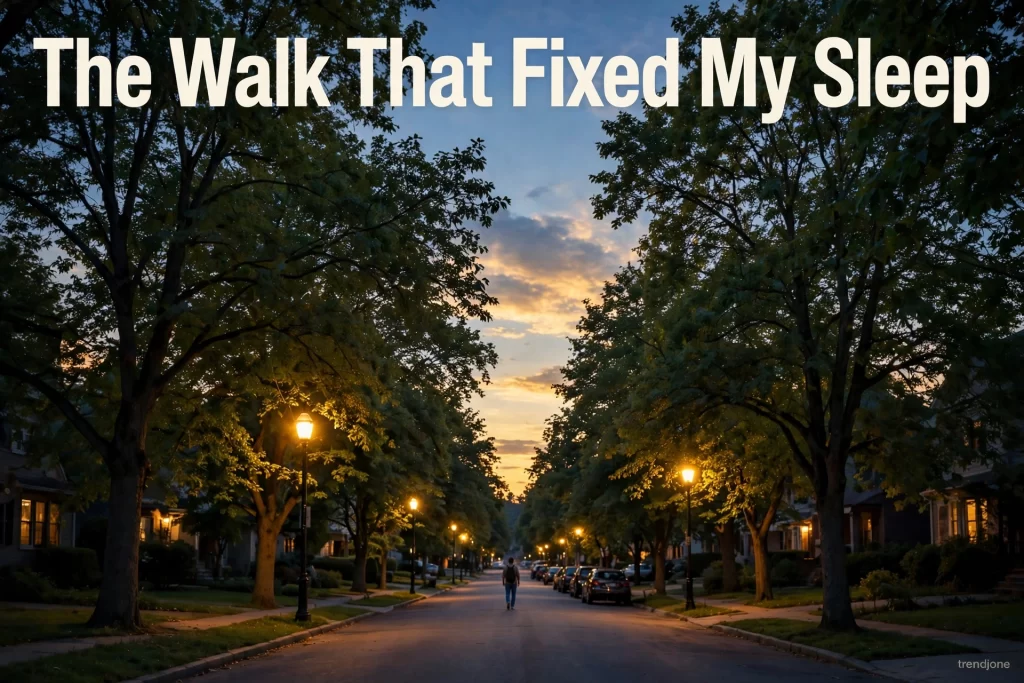
The walk started by accident. One evening, restless and tired of my own bedroom, I went out after dinner just to get out of the house. No plan, no route, no step goal — I walked around the block a few times until my legs felt pleasantly tired, and came home to the best night’s sleep I had had in weeks. I assumed it was a coincidence. The second night it happened again. By the end of the second week, it was not a coincidence anymore; it was a routine. I have kept it up for months now, and I cancelled the sleep app. Looking back, that was when an evening walk better sleep routine really took hold.
Why an Evening Walk Better Sleep Routine Beats a Morning Walk
Morning walks are wonderful for energy, and I am not arguing against them. But for sleep specifically, evening wins for a simple reason: timing. An evening walk sits between your day and your night, and it acts as a boundary. Work emails, household stress, the day’s unresolved conversations — the walk gives them somewhere to go before bed, instead of letting them follow you under the blanket.
There is also a physical reason. Gentle movement raises your body temperature slightly, and the cool-down afterwards is one of the body’s natural sleep signals — the same reason a warm shower before bed helps. An evening walk triggers that cool-down right when you want it: in the hour or two before sleep. A morning walk’s cool-down happens at 9 AM, which is useful for alertness but does nothing for the night.
One caution: keep it gentle. A hard run or intense workout in the late evening can wake you up instead, because it raises adrenaline and core temperature too much, too late. The evening walk works precisely because it is not exercise in the punishing sense — it is movement at talking pace.
What the Walk Actually Does to Your Evening
The first change I noticed was not sleep at all — it was the hour after dinner. Before the walk, that hour belonged to my phone: scrolling, half-watching something, checking messages I had already read. It felt like rest, but it was not restful; it was stimulation dressed as relaxation, and it pushed sleep later every night. That calmer hour is a big part of why an evening walk better sleep routine works.
The walk replaced that hour with something genuinely restful: moving air, changing scenery, the small mental work of noticing the street instead of a feed. I came home calmer, slightly tired in the good way, and — this surprised me — less hungry for a late-night snack. The walk seemed to settle the evening appetite that scrolling used to feed. It is the simplest part of an evening walk better sleep routine to keep.
The second change was the sleep itself: I fell asleep in twenty minutes instead of an hour, and I stopped waking at 3 AM with my mind replaying the day. The day had already been replayed, on the walk, at walking pace, where it could not spiral the way it does at 3 AM in a dark room.
How to Start an Evening Walk Better Sleep Routine (and Actually Keep It Up)
Start embarrassingly small. Ten minutes counts. The goal for the first week is not fitness; it is the habit — shoes on, out the door, after dinner, every day. I started with two laps of my block, which took about twelve minutes, and added a lap every few days until I reached thirty. Nobody needs to know you started at twelve minutes. The habit is the achievement; the distance follows on its own. That small-start approach is what makes an evening walk better sleep routine stick.
Pick a fixed trigger, not a fixed time. “After dinner” survives busy days better than “at 8 PM”, because dinner moves but always happens. Keep your walking shoes by the door, not in a cupboard — friction kills habits faster than laziness does. And leave the phone behind when you can, or at least in your pocket on silent. A walk with a podcast is still a walk, but a walk with no input is where the mental unwinding happens. Try both and notice the difference. A fixed trigger makes an evening walk better sleep routine automatic, not a nightly decision.
Bad weather is the habit’s first real test. My rule: light rain still counts (a jacket, a shorter route); heavy rain or unsafe streets mean walking indoors — around the building, up and down stairs, or even laps of a large room. The point is the movement and the boundary, not the scenery. A missed day is not a failed habit; two missed days in a row is where habits actually die, so never let one miss become two.
What It Will Not Fix
Honesty requires this section. A walk will not fix sleep problems that are medical: persistent insomnia, loud snoring with pauses in breathing, or sleep that stays broken for months despite good habits are worth a doctor’s visit, not a blog post. It also will not fix a bedroom that is too hot, too bright, or too noisy — those need their own fixes. What the walk does, reliably, is fix the very common version of bad sleep: a mind that cannot switch off and a body that has not moved enough all day. If that sounds like your sleep, the walk is the cheapest experiment you can run.
FAQ
Is 30 minutes necessary, or will 15 minutes help?
Fifteen minutes helps, and it is a fine start. Thirty is where I noticed the full effect, but a daily fifteen-minute walk beats a weekly hour-long walk for sleep — consistency matters more than duration.
Should I walk before or after dinner?
After dinner works best for most people: it aids digestion, uses the post-meal energy dip instead of fighting it, and sits naturally between day and night. If after dinner is impossible, any evening walk beats none.
Can I listen to music or a podcast on the walk?
Yes, but try a few silent walks first. Music is fine; a podcast that demands attention can keep your mind in work mode. The unwinding effect is strongest when the walk itself is the activity.
What if my area is not safe or pleasant to walk in the evening?
Walk with someone, choose well-lit main roads, or walk indoors — a building corridor, a mall, stairs. The sleep benefit comes from gentle movement and the day-night boundary, not from a picturesque route.
How long before I notice better sleep?
Most people I have talked to notice a difference within a week; give it a full two weeks of daily walks before deciding. If nothing changes in two weeks, the cause of your sleep trouble probably lies elsewhere. That gives an evening walk better sleep routine time to settle in.
Closing
I still own the fancy pillow. The white-noise machine is in a cupboard. The sleep app is cancelled. What I kept is free, takes thirty minutes, and has done more for my nights than all of them combined: shoes on after dinner, out the door, around the block, home again. If your sleep is the kind that comes from a mind that will not switch off, try it for two weeks. The worst outcome is a fortnight of pleasant evening walks — and the best outcome is the one I got, which is sleep that arrives on its own, without a gadget negotiating for it. For me, an evening walk better sleep routine remains the simplest sleep fix I have found.
Before spending on sleep gadgets, I also checked whether detox foot pads actually work, and I found the overview of sleep useful for understanding why the wind-down matters.