
The short answer
My laundry corner was not messy because I was lazy. It was messy because it had no system: one basket for everything, nowhere to sort, nowhere to hang, and a drying rack that lived wherever it was dropped. The fix was a set of small finds that gave every stage of laundry a home — a divided sorter so sorting happens automatically, wall hooks so “clean but not put away” clothes stop living on a chair, a foldable wall-mounted drying rack so the floor stays clear, and a small caddy that keeps supplies in one grab-and-go spot. Nothing cost much. The mountain is gone because the laundry corner finally has a system.
The chair that told the truth
Every home has a chair like mine had. It was not a chair anyone sat on. It was where clean clothes went to wait — the shirt you will wear tomorrow, the jeans that are clean but you are not sure are clean enough, the towel you used once. Within days the chair was a mountain, and the mountain was where clean clothes went to die. Not dirty, not clean, just… waiting.
Here is what I finally admitted: the chair was not the problem. The chair was the symptom. The problem was that clean clothes had nowhere to go between the line and the wardrobe. That gap — between “done” and “put away” — is where laundry piles are born.
Any system that fixes a laundry corner has to fix that gap. It has to make the next step easier than dumping. That is the test I used for every find below: does it make the next step the easy step? If yes, it stays. If it adds a step, it goes.
Find 1: A divided sorter that sorts for you
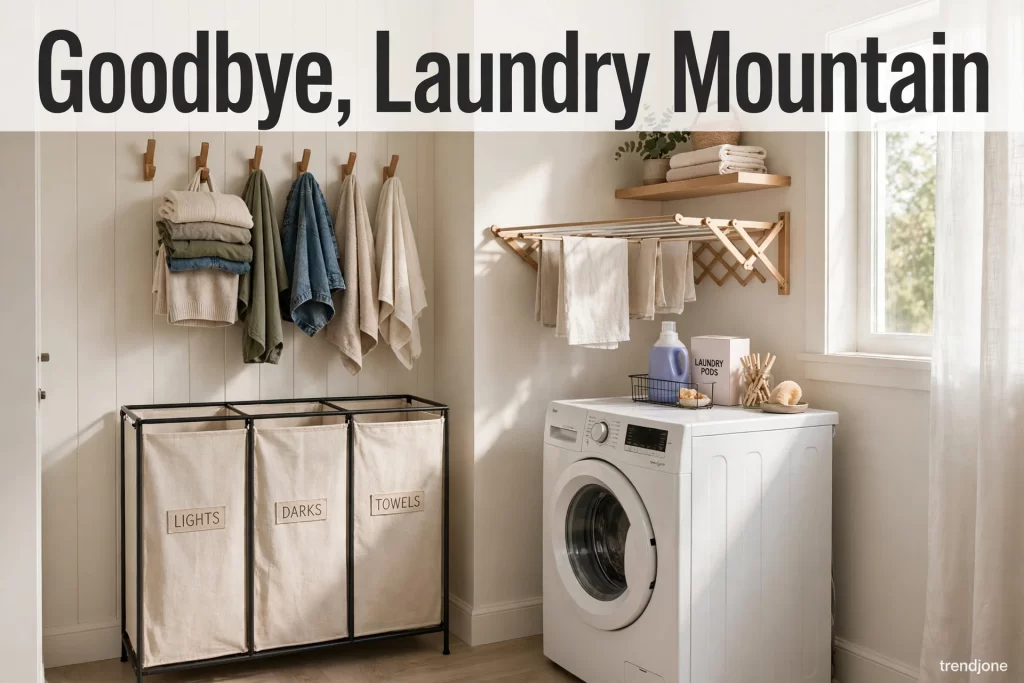
The single most effective change was a divided laundry sorter — one frame with two or three compartments, labelled for lights and darks. Sorting now happens at the moment clothes go in the basket, not at the machine. It is not a clever system; it is a system that removes a step, which is the only kind that survives.
Before the sorter, sorting was a job I did at the machine, digging through a mixed basket, holding things up to the light, dropping things on the floor. It took ten minutes and a bad mood. Now the basket arrives sorted, and the machine gets loaded in two minutes. The sorter did not save ten minutes; it saved the mood that used to cancel laundry altogether.
Buy the sorter that fits your laundry corner, not the biggest one. Mine is a slim two-compartment sorter that tucks into the gap beside the machine, and it holds roughly two days of clothes. A sorter that is too big becomes a second mountain; a sorter that fits becomes part of the room.
Find 2: Wall hooks that killed the chair
The chair mountain died the day I put up a row of wall hooks near the laundry corner. Five sturdy hooks, two screws each, mounted at a height that keeps clothes off the floor. It took twenty minutes, and it was the single biggest change in the house — because it gave clean clothes a place to go that was easier than the chair.
Now, clothes that come off the line or out of the dryer and are not going straight into a drawer get hung on a hook straight away. The rule is simple: a hanger comes off the hook, clothes go on the hanger, the hanger goes back on the hook. No pile, no chair, no “I’ll put it away later.” It works because it is exactly the buffer a real household needs, and because the clothes are visible and hanging, they actually get put away — unlike a pile, which hides wrinkles and forgotten items at the bottom.
This is the find I would recommend to anyone even if they buy nothing else. A pile hides; hanging reveals. The chair is empty now, and — I cannot overstate how satisfying this is — people actually sit on it.
Find 3: A wall-mounted drying rack that folds away
My old drying rack was a floor-standing accordion that lived permanently open in the middle of the room, because folding it up and dragging it to a corner was a chore I never did. It blocked the door, it collected things draped over it “temporarily,” and it made the whole corner feel like a laundry warehouse.
The replacement is a wall-mounted, foldable drying rack. When it is up, it holds a full load. When it is down, it is nearly flat against the wall and the floor is clear. The difference in how the room feels is enormous — the laundry corner stops being a drying room and goes back to being part of the home.
Two things to check before buying one: make sure your wall can hold it (a solid wall or proper wall plugs for plasterboard), and measure your longest items. A rack that cannot fit a bedsheet without it pooling on the floor is a rack you will stop using. Mine fits a double sheet folded once, which covers everything I actually wash.
If wall-mounting is not an option in a rented home, the next best thing is a compact folding rack with a small footprint that you genuinely fold after every use — and the honest test is whether you folded it last week. If you did not, the wall-mounted version is worth asking the landlord about; most landlords say yes to two small screws that can be filled later.
Find 4: A caddy that ends the supply hunt
Laundry supplies used to live in three places in my home: detergent on top of the machine, stain remover somewhere in a cupboard, and the mesh wash bags in a drawer I never opened. Every wash started with a small hunt, and hunts are how loads get postponed. A laundry corner without a caddy is a scavenger hunt before every wash.
A small caddy — basically a handled tote — now holds everything: detergent, stain remover, a couple of mesh bags, and a stain brush. It lives on top of the machine, it moves to the machine in one grab, and when something runs out, I notice immediately instead of discovering it mid-load. This is the least exciting find on the list and one of the most useful, because it removes friction from the very start of the job.
Inside the caddy, one detail matters: a mesh bag for delicates and small items. Socks used to vanish in my house at a rate I now find embarrassing. Since delicates and socks go into a mesh bag before the wash, they come out together. The odd-sock drawer is closed. I will not pretend this changed my life, but it did end a daily low-grade annoyance, and those add up.
Find 5: The small habits that make the laundry corner work
I want to be honest: the finds alone did not fix the laundry corner until I attached tiny habits to them. Three habits, each under a minute:
One load a day, or one load every other day, beats a weekend laundry marathon. A marathon creates the mountain; a steady rhythm prevents it. I run a load when a sorter compartment is full, not when I “feel like doing laundry.”
Fold at the machine, not later. Clothes folded straight out of the dryer or off the line, standing at the machine, take about four minutes. Clothes carried to a bed “to fold later” take four minutes plus the three days they sit there. The hook row exists for the exceptions, not as the default.
Empty the lint filter and wipe the machine seal every time. This is not just cleanliness — a clogged filter genuinely slows drying, and a damp seal grows the smell that makes “clean” clothes smell not-clean. Thirty seconds, every load, no exceptions.
What I did not buy (and why)
I did not buy a bigger machine. A bigger drum would have let me do fewer, larger loads, which sounds efficient but would have made the mountain worse — bigger loads mean bigger folding sessions, which mean more postponing. The right machine size is the one whose load you can fold in one go.
I did not buy a fancy ironing station or a steamer tower. A small handheld steamer lives on a hook by the laundry corner and handles the one or two wrinkled items per load that actually need it. Most clothes do not need pressing if they are hung promptly — another reason the hook row matters.
I did not buy matching baskets in three sizes. Matching looks good in a photo and does nothing for the system. One sorter, one caddy, hooks, and a rack — that is the whole kit.
The laundry corner now
My laundry corner today is almost boring, and I mean that as praise. The sorter stands in its gap, one compartment filling quietly through the week. The hooks hold today’s hangers. The rack is folded flat against the wall. The caddy sits on the machine. The chair is a chair again. Total spend was modest, total drilling was zero, and the daily time laundry takes is actually less than before, because I stopped re-washing things that sat in a pile and stopped hunting for supplies.
Laundry will never be fun. But it can stop being a mountain. A laundry corner just needs a system small enough to actually live in your home.
FAQ
What is the best laundry sorter for a small space?
A slim two- or three-compartment sorter that fits the gap beside your machine. Measure the gap first — the sorter that fits is the one you will use. Two compartments (lights and darks) cover most households; add a mesh bag on a hook for delicates.
How do I stop clean clothes piling on a chair?
Give them a better destination: a row of wall hooks near the laundry corner. The rule is simple — clean clothes on a hanger go on a hook, not on furniture. Because hanging clothes stay visible and wrinkle-free, they actually get put away.
Is a wall-mounted drying rack worth it in a rented home?
Yes, if your landlord agrees to two small screws (most do, since the holes are easy to fill). The floor space it saves is the difference between a laundry corner and a laundry warehouse. If drilling is truly not allowed, choose a compact rack you will genuinely fold after every use.
How do I stop losing socks in the wash?
Wash socks and small items in a zipped mesh bag. They go in together and come out together. It is the simplest fix in laundry, and it works from the first wash.
How often should I do laundry to avoid pile-ups?
When a sorter compartment is full — usually one load a day or every other day for a household. Small, regular loads beat a weekend marathon, because a load you can fold in one go actually gets folded.