
Table of Contents
Short answer: A slow morning after Diwali routine skips the guilt and the marathon clean. Start with water and light food, open the windows, do one gentle 30-minute tidy (not a deep clean), put one diya or flower where you’ll see it, eat a real breakfast, and let the rest wait until tomorrow. The house doesn’t need to be perfect today — it needs to feel calm again, and so do you.
Diwali night always runs long. The last diya is lit at midnight, the last guest leaves at one, and the last photo is taken when everyone’s already half asleep. Then the morning arrives — bright, quiet, and carrying the smell of last night’s sweets, the sight of a house that celebrated hard, and a body that is running on sugar and very little sleep. For years, my instinct was to fix everything immediately: up at seven, cleaning like a person possessed, and by noon I was exhausted, irritable, and the house still wasn’t done.
Now I do the opposite — a slow morning after Diwali routine, gentle and honest about what a tired person can actually do. This is it.
1. Water first, phone later
The first ten minutes set the tone for the whole day, and the wrong first ten minutes — scrolling through last night’s photos, reading the news, answering the family group — turn a slow morning into a stressful one. Before the phone, drink a big glass of water. Diwali food is rich, salty and sweet all at once, and a night of it leaves most of us mildly dehydrated, which is half of why the morning feels so heavy. Then make something warm and simple — chai, or just hot water with lemon — and sit with it for five minutes. Not working, not planning, just sitting.
The house can wait ten minutes. The cleanup can wait ten minutes. Everything can wait ten minutes, and the difference between starting the day rushed and starting it settled is exactly those ten minutes. The phone, the photos, the messages — they’ll all still be there at 9 am, and you’ll deal with them better after water and warmth. Ten quiet minutes at the start are what make the whole morning after Diwali routine work. On ordinary winter mornings I follow the same slow start — my winter morning routine is built on exactly this: water, light and ten unhurried minutes.
2. Open the windows and let the night out
After a night of diyas, candles, incense and a house full of people, the air inside is stale — sweet, smoky, and heavy. Open every window, even for twenty minutes, and let the morning air move through the house. It’s the single cheapest reset there is: fresh air changes how a room feels more than any cleaning product, and it clears the smoke smell that no amount of wiping removes.
If the morning is cool, even better — the cool air wakes you up without caffeine. While the windows are open, pull the curtains back and let the daylight in. Last night the house glowed with diyas; this morning it should glow with sunlight, and that change of light tells your brain, quietly, that the festival is over and the ordinary day has begun — and that the ordinary day is fine.
Fresh air is the cheapest win in any morning after Diwali routine — it costs nothing and changes how every room feels. The same idea works before the festival too — a calm Diwali week keeps the days leading up to it from becoming a rush.
3. The 30-minute gentle tidy at the heart of the morning after Diwali routine
Here’s the rule that saves the whole day: today is for a tidy, not a clean. Set a timer for thirty minutes and do only the things that make the house feel livable again — clear the plates and glasses, throw away the obvious rubbish, stack the diyas in one place, fold the blankets, put the sweets away in boxes. Don’t mop, don’t scrub, don’t reorganise anything. The deep clean is tomorrow’s job, when you have energy and the house has had a day to breathe. A thirty-minute tidy gives you a house you can sit in comfortably, and that’s all today needs.
If something isn’t done in thirty minutes, it goes on tomorrow’s list — not on today’s conscience. The timer matters, because without it, a tidy quietly becomes a clean, the clean becomes a deep clean, and suddenly it’s 2 pm, you’re exhausted, and you’ve spent the whole day after the festival cleaning up the festival instead of enjoying the fact that it happened. That is the whole point of a slow morning after Diwali routine — the festival was for celebrating, not for spending the next day cleaning it up.
4. One small beautiful thing, kept out
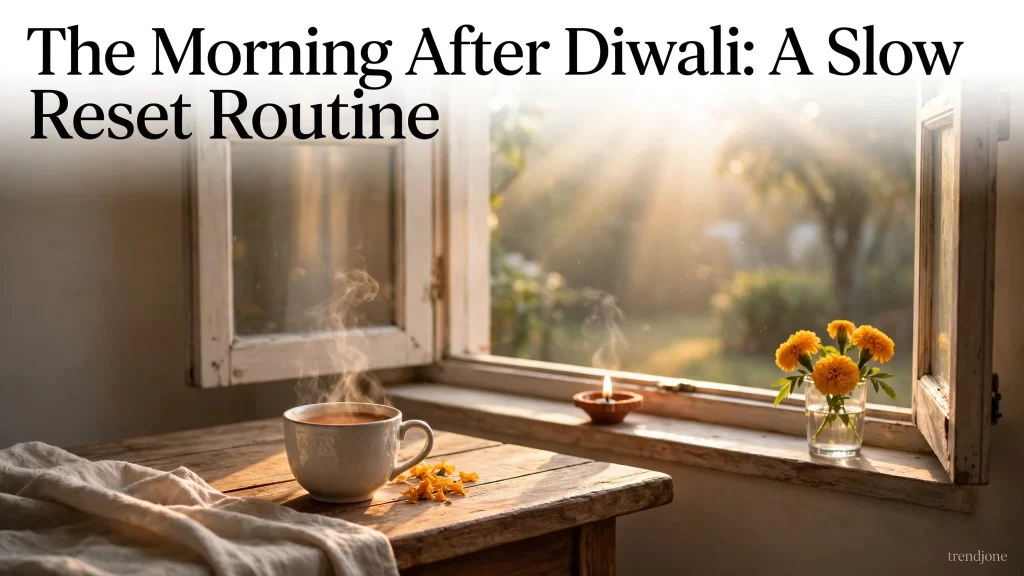
Most people pack everything away the morning after, and the house goes from festival to bare in a single hour — which feels like a loss, and it is. Instead, keep one small beautiful thing out. One diya on the windowsill, one string of fairy lights left up in the living room, a few marigolds in a glass on the dining table. Just one. It keeps a little of last night’s warmth in the house while everything else goes back to normal, and it makes the house feel like it celebrated rather than like it was raided.
Leave it for a few days, then pack it away when you’re ready. This is the part of the morning after Diwali routine that has nothing to do with cleaning and everything to do with how a home feels — a house that goes from Diwali to nothing overnight feels empty, but a house that keeps one small light feels like it’s still smiling.
5. A real breakfast, eaten sitting down
After a night of sweets and snacks, the body wants something real — and the temptation is to skip breakfast entirely, or to keep grazing on leftover mithai. Don’t. Make a proper breakfast — parathas, poha, idli, eggs, whatever your house eats on a normal morning — and eat it sitting down, at the table, with the family if they’re around. It sounds trivial and it’s the most grounding thing in this whole morning after Diwali routine: a real meal at a real table is the signal that normal life is back, and normal life is good.
Drink water with it, not just chai, and save the leftover sweets for after lunch, in a small portion, instead of letting them be the whole morning. Your stomach will thank you, your energy will hold until lunch, and the day will feel like a day instead of a long, sugary blur. Breakfast is the quiet anchor of the morning after Diwali routine — the moment the day turns from festival back to normal.
6. Rest without guilt — the last step of the morning after Diwali routine
The last part of the morning after Diwali routine is the hardest for most of us: rest, and don’t feel guilty about it. Diwali is a marathon — days of cleaning, shopping, cooking, hosting and celebrating — and the morning after is the finish line, not the start of the next race. A nap in the afternoon isn’t laziness; it’s recovery, and you’ll enjoy the rest of the week far more for it.
Read a book, sit in the sun, call the relative you didn’t get to talk to properly last night. And before the day ends, write one small plan for tomorrow: the deep clean, the decoration storage, the thank-you messages. One list, three or four lines, on paper or on your phone. Tomorrow you’ll wake up with energy and a plan, and the house will get its proper clean — but today, today is for resting in a house that celebrated well. The same slow approach works on ordinary weeks too — I use a Sunday evening reset to make Monday feel shorter.
FAQ
What should I do the morning after Diwali?
Drink water before touching your phone, open the windows for fresh air, do a gentle 30-minute tidy (not a deep clean), keep one small decoration out, eat a real breakfast sitting down, and rest without guilt. The deep clean is tomorrow’s job. That is the whole morning after Diwali routine in one breath — water, air, a short tidy, one beautiful thing, breakfast and rest.
Should I clean the whole house the day after Diwali?
No — a full clean the morning after, when you’re tired and the house is at its messiest, usually ends in exhaustion. Do a 30-minute tidy today so the house feels livable, and save the deep clean for tomorrow when you have energy.
How do I get rid of the smoke smell after Diwali?
Open every window for at least twenty minutes and let fresh air move through the house. Fresh air clears the diya and incense smell far better than sprays or wiping, and daylight coming in helps the house feel normal again.
Why do I feel so tired the morning after Diwali?
Days of preparation, a late night, rich food and very little sleep add up — mild dehydration and a sugar-heavy night make the morning feel heavier than it is. Water, a real breakfast and a proper rest usually fix most of it within a day. That is also why a gentle morning after Diwali routine works — it lets the body recover instead of pushing it.
Should I pack away all Diwali decorations immediately?
Not all of them. Pack the bulk away properly the same week, but keep one small beautiful thing — a diya, a string of lights, a few flowers — out for a few days. It keeps the warmth of the festival in the house while everything else returns to normal.