
Table of Contents
Short answer: The Diwali glow comes from seven small finds: brass or clay diyas with ghee or oil, one or two warm-white fairy light strings (not five), LED flameless candles for shelves and corners kids can reach, a simple toran or marigold garland for the door, a lantern or two for the balcony, a rangoli with a diya in the middle, and one statement piece — a hanging light or a cluster of diyas — at the entrance. Warm light, low clutter, and everything placed where people actually look. That’s the whole formula — seven Diwali lights and diyas, nothing more.
Every year I make the same mistake in the first week of November. I buy lights — too many lights — because the market is full of them and they are cheap and they look magical in the shop. Then I come home, drape them over everything I can reach, and by Diwali evening the house looks less like a festival and more like a warehouse that exploded. Wires across the walkway, a string light blinking in a colour nobody chose, one diya knocked over because I put it where people walk. The glow is there, technically. The feeling isn’t.
It took me a few Diwalis to learn that the houses that look best on Diwali night aren’t the ones with the most lights. They’re the ones where somebody chose a few good things and put them in the right places. Warm light beats bright light. A cluster beats a scatter. And the entrance matters more than any other room, because that’s where the festival actually starts. This year I kept the list to seven finds — all cheap, all reusable, all things I’ve actually used — and the house looked better with less.
These Diwali lights and diyas are the complete list. If you want more ideas in the same price band, these Diwali home decor finds under ₹500 look way more expensive than they are.
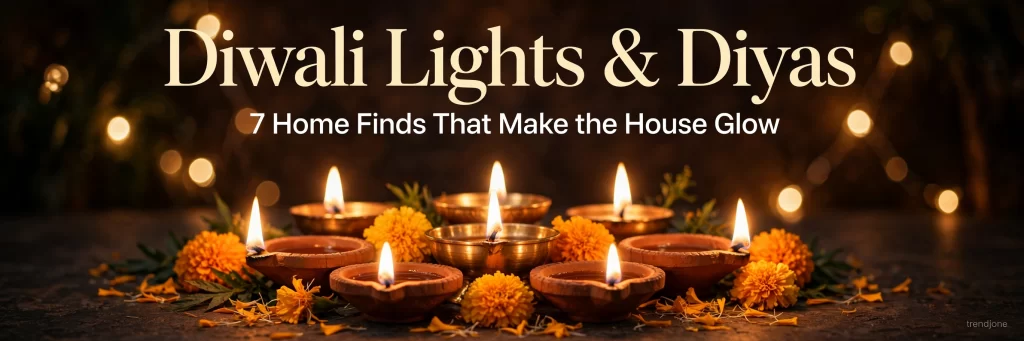
1. Real diyas: clay or brass, oil or ghee — the heart of Diwali lights and diyas
Nothing replaces a real flame, and this is the one place I won’t compromise. A clay diya costs almost nothing, a brass one lasts for years, and either one with a little oil or ghee gives a warm, flickering light that no LED has ever matched. The trick is placement: diyas belong in clusters, not in a lonely line. Three diyas together on a brass plate by the entrance, five along a windowsill, a ring of them around the rangoli. A single diya in the middle of a big empty surface looks lost; a cluster looks intentional.
Put a little rice or sand in the plate underneath and the diya sits steady instead of sliding around — that one small habit has saved me from more than one oil stain on a good tablecloth. And keep them away from curtains, paper decorations and anywhere a child or a pet runs past. The flame is the point, but so is not spending Diwali night mopping oil off the floor. No LED has matched a real flame yet — and that’s why real diyas are the first of these Diwali lights and diyas, not the last.
2. One good string of warm-white fairy lights
If you buy only one electric light, make it a warm-white fairy light string — not cool white, not multi-colour, not the blinking kind. Warm white is the colour of diya light, so it blends with the real flames instead of fighting them. Cool white makes a room look like an office; multi-colour makes it look like a fairground. One string, 5–10 metres, draped along the balcony railing or around the main door frame, is enough for most homes.
The mistake is buying three strings and wrapping every railing, window and plant in the house. Pick the one place people look at first — usually the entrance or the balcony — and light that well. Everything else can stay dark; darkness is what makes the lit parts glow. Check the wire length before you buy: the distance from the plug point to where you want the lights is always longer than you think, and an extension cord trailing across the floor is both ugly and a tripping hazard on a night when the house is full of people. One string of warm-white is the only electric light these Diwali lights and diyas need — darkness does the rest.
3. LED flameless candles for the risky spots
There are places in every house where a real flame is a bad idea — a bookshelf, a low table where kids reach, a corner near curtains, the bathroom. That’s what LED flameless candles are for. The good ones have a flickering warm flame effect and look surprisingly real from a metre away; the bad ones look like a torch in a plastic cup. The difference is usually the colour temperature and the flicker — buy warm white with a realistic flicker, and avoid the ones that glow steady like a bulb.
I use them inside lanterns on shelves and on the dining table as a centrepiece, places where a real diya would either be knocked over or set something alight. They run on batteries, they switch off with a timer, and you can leave them on all evening without a second thought. They’re the one Diwali purchase that also gets used the rest of the year — on a power cut, on a dinner table, in a bedroom when you want low light. LED candles are the Diwali lights and diyas for the risky spots — same glow, no flame to watch.
4. A toran or marigold garland for the door
The door is the first thing anyone sees, and a toran or a marigold garland is the fastest way to make it feel like Diwali. Fresh marigold garlands are cheap, they smell wonderful, and they last the evening easily — but they wilt by morning, so buy them on Diwali day itself, not two days before. If you want something that survives the whole week, an artificial toran in marigold orange with a few mango leaves does the job and folds away for next year.
Either way, the trick is the same as the diyas: one good garland, hung straight, beats three tangled ones. Measure the door width before you buy — a garland that’s too short looks like a mistake, and one that’s too long drags on the floor and gets stepped on. A small pair of diyas on either side of the doorstep completes it, and the whole entrance is done in ten minutes. One good garland is part of these Diwali lights and diyas — the door is where the festival starts.
5. Lanterns for the balcony and corners
A lantern is the best way to put a flame somewhere high or outside, because the glass protects it from the wind and the flame stays alive all evening. One or two lanterns on the balcony — with a real diya or an LED candle inside — give you a focal point that you can see from the street, which is half the point of Diwali lighting.
The same lantern works on a dark corner inside the house, on a staircase landing, or on the dining table. Buy metal or wood, not the flimsy plastic kind that melts near a real flame, and check that the glass panel opens easily, because you’ll be lighting and re-lighting the diya inside it. A lantern with a handle is worth the extra few rupees — you can carry it from the balcony to the table when guests move inside, and it becomes the light that follows the party. A lantern also makes one of the best Diwali gifts under ₹999 — pretty, useful, and it doesn’t look cheap. Of all these Diwali lights and diyas, the handled lantern is my favourite.
6. A rangoli with a diya at its centre
The rangoli is the one decoration that doesn’t need buying — you need colours, a flat surface, and half an hour — but a small diya or a cluster of three in the centre turns it from a floor design into the glowing heart of the entrance. If drawing a rangoli feels intimidating, start small: a simple circle with petals around it, or a ready-made rangoli sticker, which genuinely looks good and takes two minutes.
The point isn’t artistic perfection, it’s that the entrance has a lit centre that people gather around. Put the rangoli where people don’t have to step over it — to the side of the doorway, not in the middle of the path — and keep the diya in a small brass plate so the oil doesn’t stain the floor colours. My honest take: a simple rangoli done well beats an ambitious one done badly, and nobody remembers the design, they remember the light. The rangoli’s lit centre is the glowing heart of these Diwali lights and diyas — people gather around light.
7. One statement piece at the entrance — the finish for Diwali lights and diyas
Every Diwali home needs one thing that makes people stop for a second when they walk in. Mine is a cluster of five brass diyas on a low wooden stool by the entrance, with a marigold garland behind it. Yours could be a hanging paper lantern, a tall brass lamp, a big bowl of floating flowers with a diya in the middle — anything with height and light in one place.
The rule: one statement, not five. If the entrance already has the toran, the diyas and the rangoli, the statement piece is the cherry on top, not another layer of clutter. Put it where the eye lands naturally when the door opens, and keep the area around it clear — a statement piece surrounded by shoes and bags isn’t a statement, it’s a shelf. This is the find that photographs well, and in a festival that lives on photos, that’s worth something. One statement, not five — that’s the rule that keeps these Diwali lights and diyas from becoming clutter.
What I skip (and why)
A few things I no longer buy, because they always disappoint. The very cheap multi-colour blinking string lights — they look exciting in the shop and terrible at home, and half the bulbs die by next year. The giant inflatable or light-up decorations — they eat electricity, they dominate the house, and they age badly.
And anything that needs an app or a remote to change colour: on Diwali night, nobody wants to find the remote. Warm light, real flame where it’s safe, LED where it isn’t, and everything in one colour family. That’s the whole philosophy, and it’s the reason this year’s house took twenty minutes to decorate instead of two hours — and looked better for it. Warm light, real flame where it’s safe, LED where it isn’t — these Diwali lights and diyas are the whole philosophy.
The twenty-minute plan
If you only have twenty minutes before guests arrive, here’s the order that works: door first (toran, two diyas at the step), entrance second (rangoli with a diya in the middle, statement piece), balcony third (fairy lights and a lantern), then the living room (LED candles on the table and shelves, one cluster of diyas). Top to bottom of the priority list, not top to bottom of the house. And after the lights are done, the living room is where the evening happens — last year a mini projector turned our Diwali night into a movie night, which is how the night ended, not how it started.
Skip the bedrooms entirely — nobody judges a Diwali by a bedroom. And once it’s done, stop. The temptation is to keep adding “one more string”, and that’s how the warehouse look happens. Light it, step back, look at it from the door the way a guest would, and if it glows, it’s done. That’s how these Diwali lights and diyas take twenty minutes, not two hours.
FAQ
How many lights do I actually need for Diwali?
Far fewer than you think. One warm-white fairy light string, a dozen real diyas, a few LED candles and one or two lanterns will light most homes beautifully. Clusters and one well-lit entrance beat lights scattered over every surface. That’s the whole count for Diwali lights and diyas — fewer lights, placed well.
Warm white or multi-colour lights for Diwali?
Warm white, almost always. It matches diya flame, looks premium, and photographs well. Multi-colour lights fight with the real flames and make the house look busy instead of glowing.
Are LED candles safe around kids and pets?
Yes — that’s their main advantage. Use LED flameless candles on low tables, shelves and anywhere a real flame could be knocked over, and keep real diyas in clusters on stable, high surfaces away from foot traffic.
How do I keep diyas from staining the floor or table?
Put every diya in a small plate with a little rice or sand underneath — it steadies the diya and catches drips. For the rangoli, keep the diya in a brass plate so oil doesn’t stain the colours.
What should I decorate first if I’m short on time?
The door, then the entrance, then the balcony. Those are the places guests actually see. Bedrooms can wait — nobody judges a Diwali by a bedroom. That order is how Diwali lights and diyas fit into twenty minutes.