Table of Contents
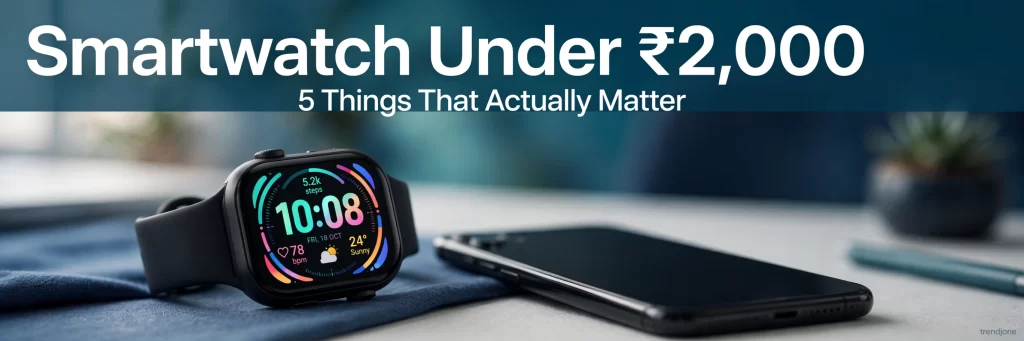
Short answer: In this smartwatch under 2000 buying guide, before buying a smartwatch under ₹2,000, check five things: a display you can actually read in sunlight, Bluetooth calling that works with your phone, a battery that lasts at least 5–7 days in real use, an app that doesn’t feel abandoned, and a strap that won’t irritate your wrist. The watch face count and the number of sports modes don’t matter nearly as much as the ads suggest.
The smartwatch under ₹2,000 is the most gifted gadget in India right now. Diwali, birthdays, Rakhi — if you need a gift that looks expensive and costs two thousand rupees, this is it. And to be fair, the category has improved enormously. Three years ago a ₹2,000 watch was a toy that died in a month. Today, some of them are genuinely good daily tools that track your steps, show your calls, and last a week on a charge. The problem is that some of them are still toys — and they all look identical in the listing photos. This smartwatch under 2000 buying guide will help you tell the genuinely good ones from the toys. If ₹2,000 is your budget for the whole home, these 8 smart home gadgets under ₹2,000 that actually cut your electricity bill are worth a look too.
I’ve bought, gifted, and lived with several budget smartwatches over the last two years, and I’ve also watched friends buy ones that ended up in a drawer by week three. The difference between the good ones and the drawer ones was never the brand name or the number of features on the box. It was five specific things, and this is the checklist I now run through before buying or recommending any watch in this price range. That checklist is what this smartwatch under 2000 buying guide is built on.
1. The display: can you read it in sunlight?
This is the single biggest difference between a good budget watch and a bad one, and it’s the hardest to judge from a listing. A watch you can’t read outdoors is a watch you’ll stop wearing. On paper, look for an AMOLED display — even a small one — over a TFT or LCD panel at this price. AMOLED screens are brighter, punchier, and far more readable in direct sunlight, and they also sip battery on dark watch faces. If the listing doesn’t say AMOLED, be suspicious; sellers who have it say so loudly. That is why this smartwatch under 2000 buying guide puts the display first.
Size matters too, but not the way ads suggest. A 1.8–2 inch display is the sweet spot for most wrists — big enough to read notifications, small enough to wear all day. Anything above 2 inches starts looking like a tiny phone strapped to your arm, and anything below 1.4 inches turns reading a message into squinting. If you can, check the watch in a store before buying; two minutes under the shop’s lights tells you more than twenty reviews. And if you’re buying online, look at user photos in reviews — real photos, not the listing images — because those show the screen in real light.
2. Bluetooth calling: the feature that decides everything
Bluetooth calling — answering calls from your wrist — is the feature that makes a budget smartwatch feel like magic in the first week and like a mistake in the second. When it works well, it’s genuinely useful: cooking, driving, hands full, you just talk to your wrist. When it works badly, the person on the other end hears you like you’re shouting from a tunnel, and you stop using it entirely. This smartwatch under 2000 buying guide treats Bluetooth calling as the make-or-break feature.
The honest truth is that call quality at this price varies wildly, and no spec sheet will tell you the truth. The microphone placement and the speaker size are what matter, and neither appears on the box. What you can check: read the 2- and 3-star reviews specifically for the words “call quality” — happy buyers rarely mention it, unhappy ones always do. If several reviews say the other side can’t hear clearly, believe them. Also check that the watch pairs properly with your phone brand — most budget watches are built for Android first, and some features behave differently on iPhones. And ask yourself honestly: will you actually take calls on your wrist, or do you just like the idea? If you mostly want notifications and step tracking, a watch without calling can be better value. A watch is only one piece of a useful setup — see why I finally bought a smart plug and the 5 things it quietly fixed.
3. Battery life: believe the 5-day rule, not the 10-day claim
Every budget smartwatch claims 7–10 days of battery. In real use — brightness up, notifications on, Bluetooth calling used a few times a day — most of them deliver 4–7 days. That’s fine, actually. Four days is plenty; it means charging twice a week, like a habit you barely notice. What you should avoid is a watch that dies in two days with normal use, because that turns the watch into a chore, and chores get abandoned. This smartwatch under 2000 buying guide uses the 5-day rule: if a watch cannot last five days in real use, it is not worth your money.
Two practical checks. First, read real-use battery reports in reviews, not the headline claim — look for “lasts 5 days” from actual buyers rather than the “10 days” on the box. Second, check the charging method. Magnetic chargers are standard now, but some cheap watches still use awkward pin chargers that are easy to lose and impossible to replace. A magnetic puck charger you can find anywhere is one less headache. And if you’re buying the watch as a gift, charge it before gifting — a dead watch in the box makes a terrible first impression. And if you want more ways to save time at home, here are 5 small gadgets that quietly save you an hour a day.
4. The app: the part nobody checks and everyone regrets
Here’s the part that separates the good budget watches from the drawer watches, and almost nobody checks it before buying: the companion app. The watch itself is just a screen and sensors — the app is where your step history lives, where your sleep data is, where the watch faces come from, and where firmware updates arrive. A bad app means your data is unreliable, your watch faces are ugly, and your watch slowly stops getting updates. This smartwatch under 2000 buying guide puts the app before the spec sheet, because the app is where your data lives.
Before buying, open the Play Store and look at the app’s recent reviews — not its star rating, its recent reviews. An app with a 4-star average but a flood of recent 1-star reviews complaining about sync failures is an app in trouble. Check the last update date too: if the app hasn’t been updated in six months, the brand has moved on to its next model, and your watch will follow. The big Indian brands tend to keep their apps alive longer than the no-name ones, which is the one place where brand actually matters in this price range. A slightly older model from a brand that still updates its app beats a brand-new model from a brand that won’t exist in a year. If the app looks abandoned, this smartwatch under 2000 buying guide says to walk away, however good the watch looks.
5. The strap and the fit: the thing that decides whether you wear it
The most accurate smartwatch in the world is useless if it sits in a drawer because the strap itches. This sounds trivial until you’ve worn a cheap silicone strap for eight hours in Indian summer — sweaty, sticky, and by evening there’s a red mark on your wrist. The good news is that most budget watches now use standard 22mm straps, which means you can swap in a decent strap for ₹200–300 and transform the experience completely. Check the strap size before buying: 22mm is the standard that gives you options; a proprietary strap locks you into one uncomfortable choice. This smartwatch under 2000 buying guide treats comfort as a deal-breaker, not a detail.
Fit matters too. A watch that’s too loose gives wrong heart-rate readings (the sensor needs contact), and one that’s too tight is miserable by afternoon. Wear it one notch looser than you think for the first day, and give your wrist a break at night — or use the sleep tracking, which is honestly one of the best features at this price, as long as the watch is comfortable enough to sleep in. If it isn’t comfortable in the shop, it won’t become comfortable at home.
What I ignore on the box
Three specs that sound impressive and barely matter: the number of sports modes (nobody uses 120 of them — you need walking, running, and maybe cycling), the number of watch faces (you’ll use two), and the claimed water resistance beyond basic splash protection (IP68 sounds great, but no ₹2,000 watch should be taken swimming regularly, whatever the box says). What does matter, and what I do check: step counting accuracy over a known walk, heart-rate readings at rest, and whether the watch actually syncs notifications from WhatsApp and SMS reliably. Those are the daily-use features, and they’re the ones that decide whether the watch earns its place on your wrist. The rest of this smartwatch under 2000 buying guide focuses on those daily-use features instead.
The bottom line of this smartwatch under 2000 buying guide
A smartwatch under ₹2,000 in 2026 is no longer a gamble — it’s a choice. The good ones are genuinely good: readable in sunlight, honest about battery, paired with an app that still gets updates, and comfortable enough to forget you’re wearing. The bad ones fail on exactly the five things above, and they fail in ways that show up in week two, long after the return window closes. Run the checklist, read the 2-star reviews, and buy the boring, reliable one over the flashy one with the bigger box. Your wrist will thank you every morning you put it on — which, after all, is the whole point.
FAQ
Is a smartwatch under ₹2,000 worth buying in 2026?
Yes, if you pick carefully. The good ones now offer a readable display, reliable notifications, 4–7 days of real battery life, and decent step and sleep tracking. The key is checking the five things in this smartwatch under 2000 buying guide — display, calling quality, battery, the app, and strap comfort — rather than trusting the feature count on the box.
Which display is best on a budget smartwatch?
AMOLED. It’s brighter and far more readable in sunlight than TFT or LCD panels at this price, and it uses less battery on dark watch faces. If the listing doesn’t mention AMOLED, the display is probably the compromise the brand made.
How long does a ₹2,000 smartwatch battery really last?
In real use — notifications on, brightness up, occasional Bluetooth calls — most deliver 4–7 days. The 10-day claims on the box assume minimal use. Four days or more is good; anything under two days with normal use is a red flag.
Can I trust Bluetooth calling on a budget watch?
Sometimes. Call quality varies a lot at this price, so read the 2- and 3-star reviews specifically for call-quality complaints before buying. If you mostly want notifications and fitness tracking, a watch without calling can be better value.
Should I buy a smartwatch online or in a store?
If you can, check it in a store first — two minutes of holding it and reading the screen tells you more than twenty reviews. If you’re buying online, rely on user photos and recent reviews of the companion app, and make sure the return window is generous.