
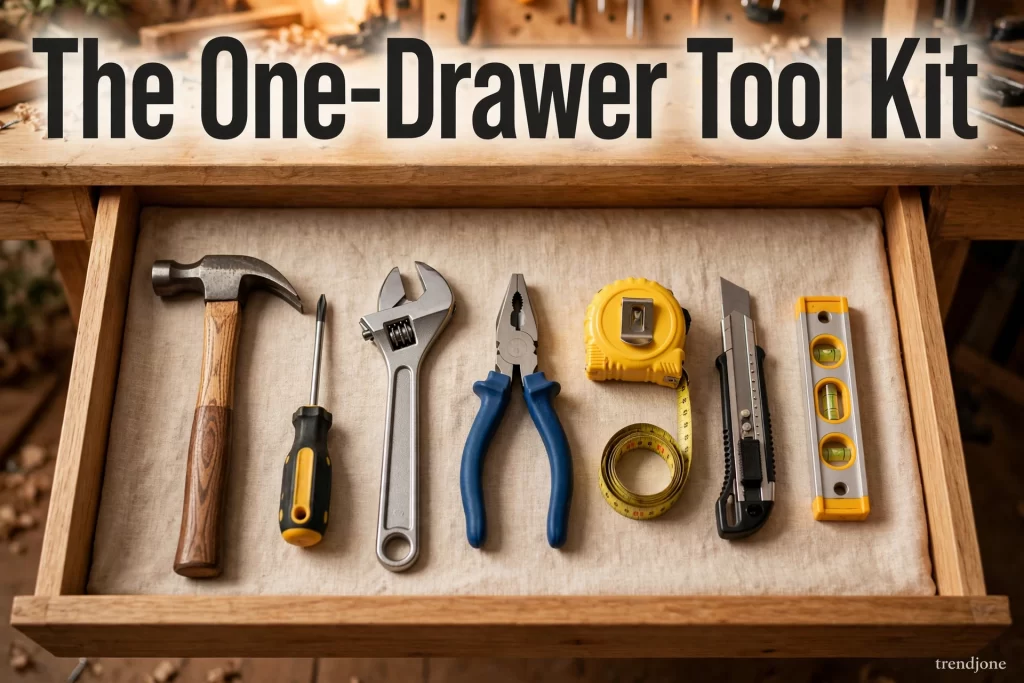
Short answer: A one-drawer tool kit with seven tools — a claw hammer, a multi-bit screwdriver, an adjustable wrench, pliers, a tape measure, a utility knife, and a spirit level — handles about 90% of everyday home fixes, from hanging frames to tightening wobbling chairs. Everything else is either a specialist job or a rental, not a purchase. That is the whole one drawer tool kit.
Table of Contents
I used to believe the opposite. My first flat had a toolbox the size of a suitcase, and I still couldn’t find the right screwdriver when a shelf bracket came loose at 9 pm. The box was full of things I had bought for one job and never touched again: a pipe wrench, three kinds of saw, a socket set I couldn’t even name properly. The irony was that every fix I actually did — and there were plenty in a rented flat with ageing fittings — used the same handful of tools, over and over.
Every tool in this kit is a hand tool, powered by hand rather than by a motor.
So I emptied the box, kept seven tools, and put them in a single kitchen drawer. Two years on, that drawer has handled everything from assembling flat-pack furniture to rehanging a bathroom cabinet door. This is the kit, why each tool earned its place, and the honest limits of it.
1. Claw hammer (16 oz is plenty)
The hammer is the tool people buy first and use worst. A 16-ounce claw hammer drives picture nails, taps furniture joints back into place, and — this is the part that matters — pulls bent nails out with the claw end. Anything heavier is overkill for indoor work and tires your wrist; anything lighter bounces off the nail. Fibreglass or steel handle, your choice; I prefer fibreglass because it dulls vibration. One honest warning: a hammer is not a demolition tool. If you are tempted to smash something off a wall with it, stop and think about what’s behind that wall.
2. Multi-bit screwdriver
Ten loose screwdrivers become one handle with interchangeable bits. Get one with Phillips, flathead, and Torx bits in the common sizes, plus a magnetic tip so you stop dropping screws behind furniture. This single tool assembles almost all flat-pack furniture, tightens door hinges, opens battery compartments, and adjusts the little screws on cupboard doors that make them hang straight. If you buy only one tool from this list, buy this one. The magnetic tip alone has saved me more crawling-under-sofa time than any other feature. In a one drawer tool kit, it earns its place first.
If you are starting from zero, start with the first toolkit I actually use.
3. Adjustable wrench (8-inch)
An adjustable wrench replaces a whole set of spanners for home use. It tightens tap fittings, assembles anything with a hex nut, and adjusts the feet on a washing machine so it stops walking across the floor during spin cycle. The trick is to adjust it snug before you pull — a loose wrench rounds off nut corners, and then nothing grips properly again. One caution from experience: never use it on a gas fitting or anything you don’t fully understand. Some jobs belong to a professional, and knowing that is part of owning tools, not a failure of it. That is why it belongs in a one drawer tool kit.
4. Combination pliers
Pliers are your third hand. They grip, bend, pull, and hold things your fingers can’t. Mine have pulled nails the claw hammer couldn’t reach, straightened a bent curtain hook, held a nut still while I tightened the bolt from the other side, and stripped a wire end when I was replacing a plug. Buy ones with comfortable, insulated grips — cheap pliers with hard plastic handles will blister your palm on any job longer than five minutes. Every one drawer tool kit needs a pair.
For renters, the shortlist looks different: 10 DIY home repair tools every renter should own.
5. Tape measure (5 metres)
Half of home frustration is guessing sizes. The tape measure ends it: will this bookshelf fit that wall, how long a curtain rod do I actually need, is the fridge gap really 60 cm or just “about”? Measure twice, buy once — the number of wrong-size purchases this has prevented in my house is embarrassing to count. A 5-metre tape with a lock button is the right size for a flat; longer tapes are heavier and harder to handle indoors.
6. Utility knife
Opening boxes, trimming a rug edge, scoring wallpaper before peeling, cutting cable ties — the utility knife does the small sharp jobs nothing else does cleanly. Keep spare blades in the drawer and change them often; a dull blade is more dangerous than a sharp one because you push harder and it slips. Retract it every single time you put it down. I learned that one the shallow way, and once was enough.
7. Small spirit level
This is the tool people skip and then regret. A 30-cm spirit level is what stands between “that shelf looks fine” and “why does everything slide to the left?” Frames, shelves, curtain rods, a wall-mounted TV — all of them look wrong when they’re even slightly off, and your eye notices even when you can’t say why. The level takes ten seconds and removes all argument about it. It is the smallest tool in the one drawer tool kit, and the easiest to skip.
What I left out of my one drawer tool kit
A power drill is the obvious omission, and it’s deliberate. For a beginner’s drawer kit, a drill is the first upgrade, not the starting point — and the moment you add power tools, you add chargers, bits, and safety reading. If you hang things often, a basic cordless drill is a great second step. But the seven hand tools above cover the fixes most people actually face in a week, and they cost a fraction of a drill kit. Similarly skipped: saws, socket sets, and anything sold in a “200-piece tool set” — those sets are mostly filler you’ll never use, padded out with bits in sizes that fit nothing in your home.
How to store your one drawer tool kit so you actually use it
The drawer matters as much as the tools. Mine has a cheap tray insert so each tool has a visible slot; when something’s missing, I notice immediately instead of discovering it mid-job. Keep the drawer near where fixes happen — kitchen or hallway, not a store room you have to psych yourself up to visit. And once a year, wipe the tools down and check the utility knife blades. Ten minutes, and the kit stays ready. That is how a one drawer tool kit stays ready instead of buried.
Once the kit is ready, put it to work: one weekend, three fixes, on the small DIY jobs I finally stopped postponing.
FAQ
How much should a beginner tool kit cost?
Decent hand tools for this kit run roughly the price of one dinner out for two — and they last years. Spend a little more on the screwdriver and pliers, which you use most; the hammer and level can be budget picks without regret.
Can I really skip a power drill?
For hanging light frames and assembling furniture, yes — hand tools suffice. A drill becomes worth it when you regularly drill into masonry or hang heavy items like wall cabinets and TVs. Rent or borrow one first; buy when you catch yourself needing it a third time.
What’s the first tool to buy if I buy only one?
The multi-bit screwdriver. Loose screws, hinges, battery covers, and flat-pack furniture all answer to it, and it’s the tool you’ll reach for most weeks.
Are cheap tool sets worth it?
Mostly no. Big piece-count sets pad their numbers with duplicate bits and tools sized for jobs you’ll never do. Seven good tools beat seventy mediocre ones, every time.
When should I call a professional instead?
Anything involving gas, main electrical wiring, or structural changes to walls. Tools give you confidence for small fixes; judgement is knowing where small fixes end.