
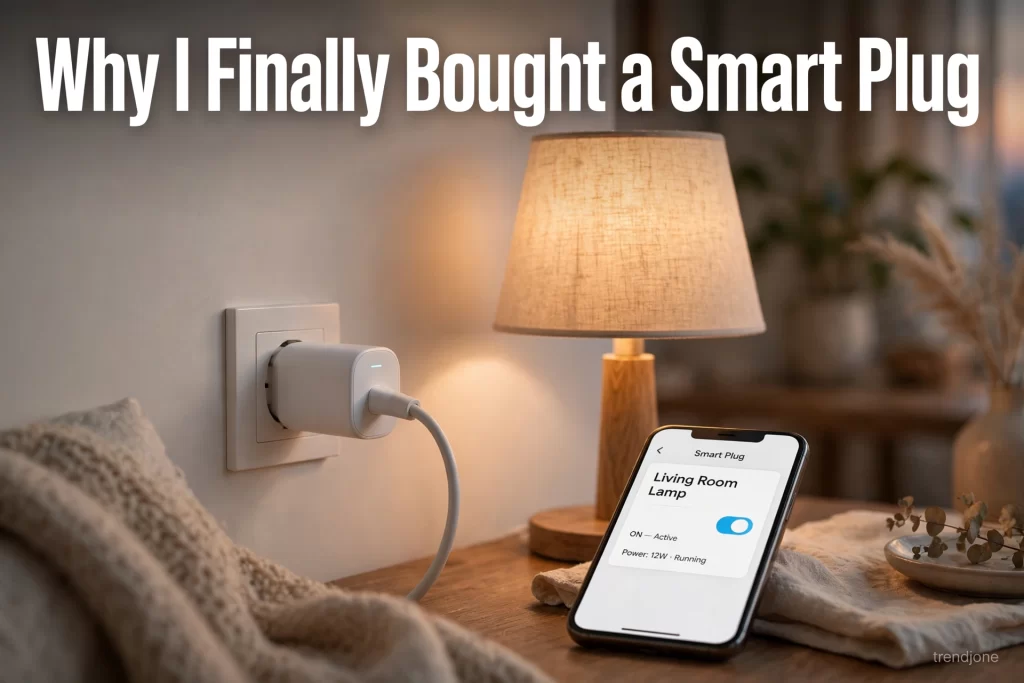
Short answer: A smart plug — a small adapter that sits between your wall socket and any appliance, controlled from your phone — quietly fixes five everyday problems: scheduled on/off for the geyser and router, remote switch-off for peace of mind, energy tracking that shows what appliances really cost, voice control for hard-to-reach sockets, and a simple on/off timer for things like phone chargers and fairy lights. It is the cheapest useful entry point into a smart home, and the only gadget I recommend without hesitation.
Table of Contents
Let me be honest about where I started: I thought smart plugs were for people who enjoy saying “Alexa, turn on the light” at parties. I had a phone, a Wi-Fi router, and zero interest in automating my flat. Then a friend left one behind after helping me move, and instead of returning it, I plugged my table lamp into it out of curiosity. That was two years ago. There are now six in my house, and none of them is used for showing off.
1. The geyser stopped eating my electricity bill, thanks to a smart plug
Our geyser used to run all day because switching it on and off manually meant remembering, and nobody remembered. With a smart plug on a schedule — on at 6 am, off at 8 am, on again at 7 pm — it heats water only when we actually bathe. The first month’s bill dropped noticeably, and the drop stayed. This is the single biggest saving in the house, and it required no behaviour change at all. The schedule does the remembering for us. If your home has any appliance that runs “just in case” — a geyser, a water heater, an old fridge in the balcony — a scheduled plug is the cheapest fix available.
For more cheap wins in the same spirit, see these 8 smart home gadgets under Rs 2000 that actually cut your electricity bill.
2. A smart plug restarts the router before I wake up
Every home Wi-Fi router eventually needs a restart, and it always needs it at the worst moment — mid-video-call, mid-download. A weekly 4 am auto-restart on the router’s smart plug keeps the connection stable, and I haven’t touched the router’s power button in a year. It’s a small thing, but “the internet just works” is one of those invisible comforts you only notice when it’s gone. One caution: don’t put the plug itself on a schedule that cuts power while a firmware update might be running; a weekly restart at an hour nobody uses the internet is the safe version.
3. “Did I leave the iron on?” is no longer a question
This one is about anxiety, not electricity. Leaving home and wondering whether the iron, the room heater, or the straightener is still on used to mean either a worried day or a trip back home. Now I open the app, see the plug is off, and move on. On the two occasions something actually was left on, I switched it off from the office. You cannot put a price on that, but if you had to, it would be far more than the plug cost. For elderly parents’ homes, this one feature alone justifies the purchase: family members can check and switch off appliances remotely.
4. Energy tracking ended arguments about the bill
Some smart plugs measure how much electricity passes through them, and the numbers are humbling. Our “small” old room heater was drawing more than the fridge, the TV, and the washing machine combined. The decorative lamp we left on all evening cost almost nothing. Once you see real numbers, you stop guessing and start deciding — which appliances deserve a schedule, which ones should be replaced, and which habits were never the problem. This is also the feature that makes the plug pay for itself: one corrected habit usually covers the cost within a few months.
5. Hard-to-reach sockets became usable again
Every home has a socket behind furniture that you can only reach by moving something heavy. Ours was behind the bed, powering a lamp. Before the smart plug, that lamp was either always on or never used. Now it switches on with the evening schedule and off at bedtime, and I never touch the socket. The same trick works for fairy lights at festivals, aquarium lights, and the charger for a device you only use on weekends — schedule it, forget it.
The same idea tames chargers too. These 7 charging gadgets finally end the cable mess at home.
What a smart plug is NOT
Fairness demands the limits. A smart plug won’t make a dumb appliance smart in any deep sense — it can only cut and restore power, so it works best with appliances that resume their last state when power returns (lamps, heaters, fans, routers). It won’t work well with a TV that needs its remote to turn back on, or a washing machine mid-cycle. It also depends on your Wi-Fi; if the router is down, remote control goes with it, though schedules stored on the plug itself usually keep running. And for heavy appliances like air conditioners, check the plug’s wattage rating first — most standard plugs top out around 10–16 amps, and overloading one is a genuine fire risk, not a hypothetical.
In short, a smart plug is the simplest entry point into home automation.
Which one to buy, honestly
Buy a plug from a known brand with an app that has decent reviews, a 16-amp rating if you plan to run a heater or geyser through it, and energy monitoring if you care about the bill (and you should — it’s the feature that pays). You don’t need a hub, you don’t need a whole ecosystem, and you definitely don’t need the most expensive one. One plug, one appliance, one week of use — that’s the honest trial. If it earns its place, buy more. Mine did, six times over.
If you like this kind of quiet win, here are 5 small gadgets that quietly save you an hour a day.
FAQ
Does a smart plug use electricity itself?
Yes, a tiny amount — roughly a watt or so on standby. It’s negligible next to the savings from scheduling a geyser or heater, but don’t plug a smart plug into something solely to save a watt elsewhere; the maths only works on real loads.
Will it work if my Wi-Fi goes down?
Remote control from outside stops, but schedules already saved on the plug usually keep running, and the physical button on the plug still works like a normal switch. Your appliance is never trapped on or off.
Can a smart plug run an air conditioner?
Only if the plug’s rating covers the AC’s draw and the AC resumes on power restore — many don’t. For ACs, a dedicated high-rated smart controller is safer than a generic plug. When in doubt, check the rating plate on the appliance first.
Is it safe to leave a heater on a smart plug?
Yes, within the plug’s amp rating and with the heater’s own thermostat working. The plug adds a schedule and remote off-switch; it doesn’t replace the heater’s safety features. Never bypass those, and never use a plug rated below the appliance’s draw.
Do I need Alexa or Google Home for it to work?
No. The plug’s own app is enough for schedules, timers, and remote control. Voice assistants are optional — convenient for lamps, unnecessary for everything else.